Showing posts with label assessment. Show all posts

Saturday, February 14, 2015

Makin' It Math Mid-Month Linky -- Money, Money, Money!

Glad you stopped by! Welcome to our Makin' It Math Mid-Month Linky--a linky dedicated solely to math made-its.  If you are interested in linking up your math made-its, check out the details by clicking the logo below.  We would love to have you join us! 

http://www.guided-math-adventures.com/p/makin-it-math-mid-month-linky.html

Our kids have been working a lot with money in the past few weeks, and are quickly becoming money masters!  We thought we would give you an inside look at our explorations and share some made-its.

Our money explorations began with a simple pretest.  Students were asked to name each coin, tell the value of each coin, and count a small selection of coins (if able).  Students were pulled to do the assessment individually with real coins while other students were engaged in math game play.  This quick assessment made it easy to group students based on need.  Four groups were formed and guided instruction of small groups began.

Small Guided Math Groups

The following have been key in our small guided groups:
  • the use of coins that students can touch/feel and manipulate
  • mastery of coin identification and values before moving on to counting (some groups moved on sooner than others and students who showed mastery quickly were worked into a different group)
  • a gradual progression in coin counting (mastery of counting like coins and adding coins from least to greatest--pennies and nickels; pennies, nickels, and dimes; pennies, nickels, dimes, and quarters)
  • multiple opportunities to count random groups of coins and write the total value using numbers and symbols (students would count a collection of coins for the group two times and the other students in the group would agree/disagree, recount to check accuracy, and discuss order in which coins were counted)
  • acceptance and discussion of multiple ways of counting (including discussion of counting on coins to create landmark tens for ease of counting remainder of coins)
  • self and peer-evaluation and justifying of thinking
  • use of the open number line to illustrate how coins were counted
  • lots and lots of practice 


Students carefully counted in their heads as their peer counted aloud.  Students then agreed or disagreed and gave proof.  Discussions of how coins were counted (order) happened here as well.


Students showed their thinking with an open number line.


Students evaluated their peers and provided justification for their thinking.  The students on the left drew faces to provide evaluation for their fellow classmates as they worked their way from desk to desk around the room.

 Students showed multiple ways to represent a dollar.

Independent Practice

The following are a few independent practice opportunities we  provided for students to work on while meeting with guided math groups (differentiated based on each group's needs and all designed for practice of money skills).  Please feel free to download any you can use.  Some were created this year and others we have used for several years.
Math Journals:

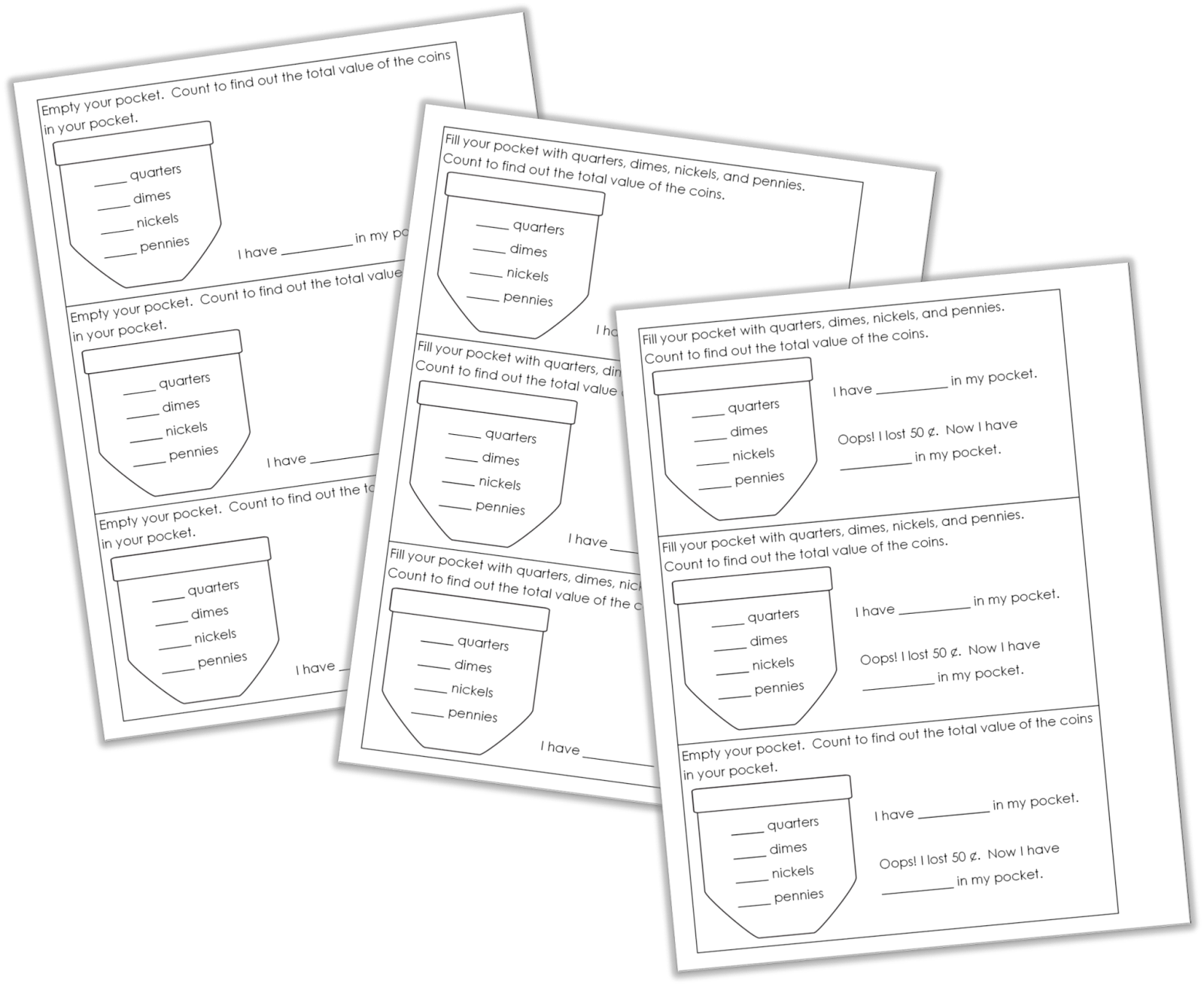
Coins in My Pocket Journal Prompts - These prompts can easily be differentiated.  My kids use half-sized notebook journals and simply cut and paste the prompts and solve.
https://drive.google.com/file/d/0B_1w1VapXOL_c3ZSeXFhZ1YyT3M/view?usp=sharing

"Show What You Know" independent tasks (premade/teacher created activity sheets, roam the room activities, Scoot activities, What's a Word Worth?, etc.) that can be used as assessment:

I don't find too many premade activity sheets that I like, but I inherited an OLD version of this workbook years ago. I think it's one of those for parents to use at home, not sure. It's great!  It follows a logical progression of practice from like coins to pennies and nickels, pennies/nickels/dimes, etc.  It also has some great problem solving sheets.  I pick and choose the sheets to use based on student need and place them in folders labeled A, B, and or C.  Cups of coins are always made available for use with these activity sheets.

What's a Word Worth?
--
I'm sure you have seen or used something like this before.  Students can use any word list and the coin key to figure out what each word is worth.  I have three different sheets made and labeled A,B, and C so students practice with the coins they can count independently.  

https://drive.google.com/file/d/0B_1w1VapXOL_dVNtN0tKTlFibWM/view?usp=sharing

Counting Coins ScootStop back to download soon!

Games:

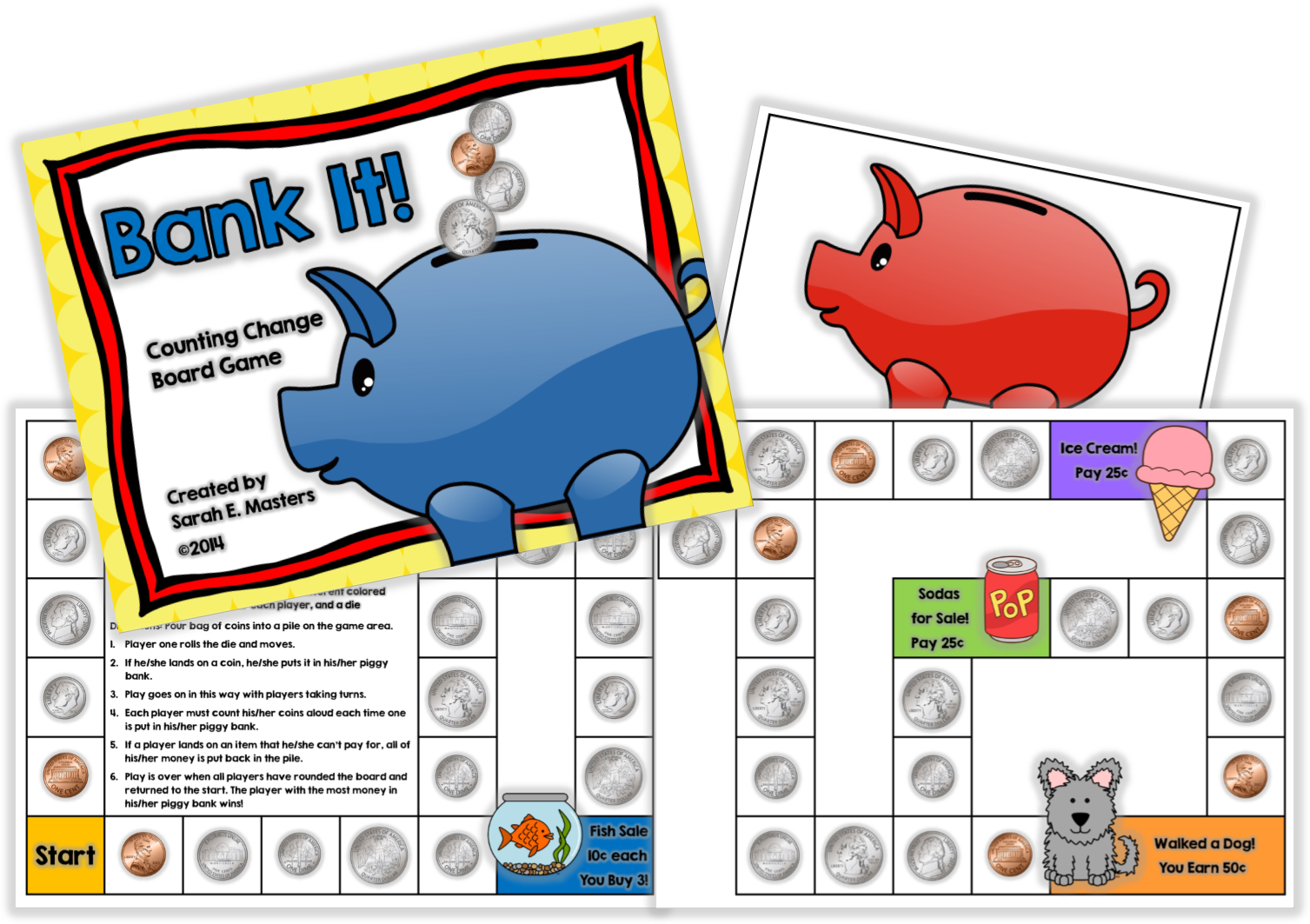
Bank It! Board Game -  This game can be played after students have learned to count pennies, nickels, dimes, and quarters.  It requires addition and subtraction of coins. My kids love this! Games like these are easy to send home for at-home practice. 

https://drive.google.com/file/d/0B_1w1VapXOL_X2p6QUNQYjJkNUk/view?usp=sharing

You may also like my This Little Piggy! Money Fun games on TpT.


Workstations (task cards, money bag activities, etc.):

Money Bags!: Coin Tasks - This differentiated workstation is used with bags of coins (fill with coins appropriate to student need).

http://www.guided-math-adventures.com/p/workstations-games_18.html
You may also like my Show Me the Money! task cards on TpT.

Assessment

Ongoing assessment is easily done in guided groups.  Much is assessed through observation.  Courtney and I also created a performance task that we use to assess students' levels of mastery.  Please feel free to download, Suzy's Piggy Bank.  If you use this task, we would love to hear your comments and thoughts about how it went.  Feel free to email us anytime!

Please share your thoughts and ideas in a comment OR link your blog post up with us!

All the best--


Saturday, August 2, 2014

Dr. Nicki Newton Q & A #1!

Thanks so much for stopping by---you've come to the right place! Today is Dr. Nicki Newton's first of two Q & As!!


Our wonderful adventurers (followers) sent in some thoughtful questions for Dr. Nicki, and her answers have been sent back! Many thanks go out to, Dr. Nicki!

Q1: What are math running records? Can you give an example?

A1: Math running records are a great way to assess the fluency of our students.  They consist of 3 parts: speed and accuracy, flexibility and efficiency. Remember when you are assessing children, you are not only concerned with quick facts but also flexibility (strategies) and efficiency (knowing what to use when). They follow the sequence of learning facts (for the addition sequence see my blogpost on the Dolch Words of Math) also see Van de Walle elementary ed math books. Also, I will be holding an online course about math running records this fall in August and September. 

Q2: Suggestions for using a curriculum (such as Saxon) in a guided math structure?

A2: I would incorporate the major cluster/priority standards lessons into the guided math structure.  You want to think about what are the absolutely non-negotiable standards - things that students have to know 100% by the end of the year... and then teach, remediate, extend those lessons in the guided math group. I would use the main lesson during the whole group part and then differentiate in the small group.

Q3: I have been moved to third grade math this year and am concerned with how I would do guided math when I look at the daily math lessons I am to teach. How does a teacher teach the lesson over and over to each group she would pull when the lessons are so involved?

A3: Ok, so as you think about structuring your year, you are not trying to teach every lesson in the group.  You are pulling groups according to their needs.  In the mini-lesson you are working with the whole class.  In your small group you are working with children in their zone of proximal development, teaching them what they need to learn.  Focus on the priority standards in the group. Also reinforce these in the workstations.

Q4: What is the most important thing for a teacher to keep in mind about Guided Math when he/she is first starting out?

A4: Start slow! Make sure you know what the other children are doing.  Make sure you have your routines and procedures well established.  Make sure the students have their toolkits.  Think about lessons that teach the priority standards.  Remember that you can start by doing 1 or 2 groups a week and then increase the amount as you get familiar with it and comfortable. 

Q5: "Interactive" math journals have exploded on the blog-osphere and Teachers Pay Teachers (cutting and pasting fold out pieces/flaps, coloring pictures to accompany prompts, etc.) How do you feel about using these?

A5: I think they can be potentially very wonderful!  You have to make sure that you aren't just doing cut and paste activities.  Make sure that you are clear about the specific standard you are teaching (and that the students understand it in the form of an I can statement). I think if you can put them in a Thinking Notebook, then they can serve as a resource throughout the year for the students. 

Do you have questions about guided math? Please send your questions to us at guidedmathadventures@gmail.com, and we will submit them for Dr. Nicki's second Q & A.  Please send your questions by the end of the day on Wednesday, August 6th.  

We'll see you tomorrow for chapter 8 of our Guided Math in Action book study!

Tuesday, July 22, 2014

Guided Math in Action Book Study -- Chapter 5

Today we are here to discuss Chapter 5 from Dr. Nicki's Guided Math in Action book. We are only discussing one chapter today, and what a great chapter it is!


Question 1: What types of pre-assessments do you use? What new ideas have you gathered from this chapter? 

I have struggled for YEARS trying to come up with an effective way to pre-assess my students math skills in the same manner I pre-assess their reading skills. In reading, I complete a running record on each student individually. I also have a little "chat" with them about reading (likes, dislikes, what they remember from first grade, etc). But when it came to math, I would give paper and pencil pre-assessments on the unit we were going to study, but in reality, the majority wouldn't do well because WE HAVEN'T LEARNED THE MATERIAL YET! I have given pre-assessments on first grade standards, which gave me a good idea of my struggling mathematicians.

I could never find a way to do the same with math....until now! Dr. Nicki has opened my eyes and the answer is so simple, do the same thing I do with reading, but only relate it to math!  I loved how she talks about having the interviews with the students and giving a little survey. Kids eat up their individual time with me and this is something I can do when beginning a new unit.
I could relate a lot of what Dr. Nicki was saying in this chapter because it is how I assess and comprehend the individual understandings of all my students when it comes to reading. My notes I take would fit right in with the sticky note sheets Sarah made....I love it when things come together for me!

Question 2: What types on on-going assessments do you use? What new ideas have you gathered from the book?

I feel the most powerful assessments any teacher can use is teacher observations and conversations with students. I use my time during guided math groups to write what I observe and the discussions we have. These observations will then lead to my next day's lesson. It's hard for me to plan out a week of guided math groups (or reading groups for that matter) lesson plans because I go off of what we have done previously. There are times that my whole time with a group is pure discussion. Dr. Nicki said, "Small-group work is the perfect time to push on mathematical thinking so that you can build adaptive reasoning" (p. 58).

I am also one that likes a formal checklist, or graphic organizer for on-going assessments. Dr. Nicki has great examples of some in her book. 

Two things to work on:
  • Observing the students when they are not in a group. Whether doing workstations, journals, or fact practice games, observing them in other settings will give me more information on their mathematical thinking.
  • Keep anecdotal notes short and to the point....I tend to write too much!

Question 3: What types of summative assessments do you use?  What new ideas have you gathered from this chapter?

I have to honest here.....the only reason I really give a summative assessment is to get a grade.  I usually will use a test from our math program, make one up myself, or get some great assessment Sarah has made (which is always much better than what I make:). I hate feeling this way, but it's the truth. Dr. Nicki does make me feel better by saying we must use information from these assessments to make sure students are learning (I also like that she calls them "Evaluative Assessments").

I want to set goals with the students like Dr. Nicki mentions on p. 63. She says, "Students shouldn't be on a mystery train. If they know where they are going, they have a much better chance of getting there." WOW...POWERFUL!

Another goal of mine is to use student portfolios. I know how wonderful they can be for students, parents, and myself, but have failed over the years with keeping up.

I believe all three assessments are essential in all classrooms, and not just with math. Knowing our students strengths, weaknesses, and interests can make us more effective educators. They also allow a so called map into what we need to do to ensure all our students are learning!

 
AND, if you have not already heard the FABULOUS news...

To our surprise, Dr. Nicki recently contacted us to offer her help with the book study in any way.  She will be doing some Q & As right here!!


As of this Wednesday, we will be over half-way through our book study, so this is a great time to ask questions that have popped into your head while reading or following along on our blog.  Dr. Nicki has generously agreed to do a second Q & A at the end of the book study as well--SO start keeping track of those burning questions!

Here's how the Q & A will work:

  1. Send your questions to us at www.guidedmathadventures@gmail.com.
  2. We will pass your questions on to Dr. Nicki.
  3. She will do her best to answer your questions in an upcoming post.

We will be taking questions for Dr. Nick's first Q & A through Wednesday, July 23, so don't delay--Get your questions in! How about some questions about assessment--a big topic??

A big THANK YOU goes out to Dr. Nicki!

We will see you back here on Sunday for Chapter 6, BUT you may want to stop back this Friday to find out about a wonderful giveaway! That is--if you like giveaways!! You can also read past book study posts by clicking HERE!