Showing posts with label book study. Show all posts

Wednesday, February 18, 2015

Number Talks Book Study -- Chapter 9

Today our book study of Number Talks by Sherry Parrish comes to a close with a brief discussion of chapter 9.


To read past book study posts, visit our Number Talks Book Study Archive

Chapter 9: What Does a Number Talk Look Like at My Grade Level?

Chapter 9 is a facilitators guided and provides a closer look at the schools/teachers highlighted in the DVD (grades K, 2, 3, and 5).

A math time structure is shared for each level and discussion questions for the videos are presented.

A school-wide perspective is also given so readers can understand the importance of consistency among number talk content from year to year even with the natural variation in personalities, classroom structures/environment, etc.

Parrish stresses the importance of/consistency in ...
  • the teaching of the big ideas in mathematics
  • instruction as asking not telling
  • the development of safe learning communities
  • an unwavering quest for making sense

Love, LOVE this closing quote from Parrish, "The mark of a master teacher is the ability to reflect on his practice."  SO TRUE! For this reason, a series of questions for personal reflection are given. 

If you have participated in this book study along with us, or have read Number Talks, you undoubtedly had many moments of personal reflection.  I have found affirmation for what I strongly believe to be true about teaching mathematics, have a new-found knowledge of the power of using the number talk structure presented in the text, and am inspired as I move forward with my students.

Even more important are the cheers I hear from my students when I say it's time for a number talk and the mathematical thinking and sharing that follows!  Thanks to Sherry Parrish for her phenomenal contribution to our profession!

Speaking of Sherry Parrish, we will announce the date of her Q & A as the day draws near, so look for a facebook shout out coming soon.


A thank you also goes out to Tara, the Elementary Math Maniac, for hosting the book study and all of our adventurers who have followed along.

Lastly--you will want to stop back this coming Sunday for another Fly on the Math Teacher's Wall Hop! The topic is fractions, so we'll see you then!


All the best--
Sarah


Thursday, February 12, 2015

Number Talks Book Study -- Chapters 7/8

Hello!  Welcome back to our Number Talks book study!  Today I discuss chapters 7 and 8--two chapters focused on multiplication and division for grades 3-5.

To read past book study posts, visit our Number Talks Book Study Archive!


Chapter 7: How Do I Develop Specific Multiplication and Division Strategies in the 3-5 Classroom? 

As in the beginning of chapter 5, Parrish presents the overreaching goals for number talks at this level: number sense, place value, fluency, properties, and connecting mathematical ideas.  For a discussion of the importance of each at the 3-5 level, visit my previous post of chapter 5. Accuracy, efficiency, and flexibility are always encouraged with number talks as well. 

Parrish goes on to stress the importance of using array models to anchor student strategies with multiplication and division.  She compares the importance of the array model with multiplication and division to the importance of the number line to addition and subtraction.  If you are not currently using arrays to help students understand the concepts/strategies associated with multiplication and division, it is important to make this shift.  With an array, students can apply their understanding of the factors/dimensions of an array to find the product/area. See array for 6 x 22 below.


From an array with boxes delineated within the area, students can move to the use of an open array.  Like an open number line, and open array can be customized to model thinking/strategies.  Below is an example of 6 x 22 and 132/6 using an open array.


Also, as presented in chapter 5 with addition and subtraction, it is important to use real-life contexts for multiplication and division, explore and discuss the efficiency of different strategies, and anticipate student thinking.

The remainder of chapter 7 illustrated five common strategies for multiplication and four common strategies for division.  I will give examples of many of these strategies as I discuss chapter 8.


Chapter 8: How Do I Design Purposeful Multiplication and Division Number Talks in the 3-5 Classroom?

The number talks presented in this chapter are organized by operations and strategies.  A rationale for helping students develop each strategy is presented and specific instructions are given for their implementation.  

Even if you are not using number talks, this chapter does an exceptional job of illustrating essential strategies for multiplication and division.

First, Parrish stresses the importance of using number talks that focus on fluency with small numbers BEFORE moving on to using those that focus on computation with greater numbers. Number talks with small numbers help students focus on strategies rather than the magnitude of numbers and foster confidence.  In this chapter, specific number talks are presented to bring about the use of specific strategies, but it is also understood that students will share other methods.  "The ultimate goal of number talks is for students to compute accurately, efficiently, and flexibly."

Multiplication Number Talks


Repeated Addition or Skip Counting:  Specific number talks are not presented for this strategy because the goal of number talks is to move students beyond additive thinking to multiplicative thinking. Praise students for using this type of thinking, but don't forget to make a connection to multiplication.

Making Landmark or "Friendly " Numbers: It is important to remember here that if an adjustment is made to one of the factors, an adjustment must also be made to the product.

Examples:

6 x 21
6 x 20 = 120
120 + 6 = 126

3 x 19
3 x 20 = 60
60 - 3 = 57

Partial Products: This strategy requires the breaking up of one or both factors into addends using expanded notation and the distributive property.  This strategy can be used with any multiplication problem.

Examples:

6 x 23
6 x (20 + 3)
6 x 20 = 120
6 x 3 = 18
120 + 18 = 138

6 x 31
(3 + 3) x 31
(3 x 31) + (3 x 31)
93 + 93 = 186

Doubling and Halving:  This strategy can be used to make problems with multiple digits easier to solve.

Example:

8 x 35
8/2 = 4
35 x 2 = 70
4 x 70 = 280

Breaking Factors Into Smaller Factors:  It is important to expose students to number talks that lead to the use of this strategy to help students understand the associative property.

Examples:

6 x 21
3 x 2 x 7 x 3

32 x 8
4 x 8 x 2 x 4

Division Number Talks

Repeated Subtraction or Sharing/Dealing Out: Specific number talks are not presented for this strategy because the goal of number talks is to move students beyond removal to multiplicative thinking. Praise students for using this type of thinking, but don't forget to make a connection to multiplication.

Partial Quotients: When the partial quotient strategy is used, students are able to understand the value of each digit in a number being divided.  No longer is there the "goes intos" thinking based on single digits without an understanding of each digit's value. When I taught fifth grade, this strategy along with the use of base ten tools helped students understand the concept of addition and set aside a series of memorized steps they had previously used. 

Here is a great post by Tara, the Elementary Math Maniac, all about teaching the partial quotient strategy--Teaching Division with Partial Quotients: Moving from Concrete to Abstract Models.

Multiplying Up:  Students build upon multiplication they know until they reach the dividend.

Example:

12 x 35

12 x 10 = 120
12 x 10 = 120
12 x 10 = 120
12 x 2 = 24
12 x 2 = 24
12 x 1 = 12

12 x 35 = 420

Proportional Reasoning: Division is considered from a fractional perspective.  Halving and halving or thirding and thirding can be explored with the number talks included.  Some number talks include: 800/40 and 144/6.

I hope you find the overview of each strategy helpful, if you have not purchased a copy of the book.  I highly recommend you do!

Please feel free to share your comments, ideas, or experiences related to chapters 6 and 7.  We would love to hear your thoughts!

AND don't forget to stop by this coming Sunday for our Makin' It Math mid month linky!

Have a fabulous Friday--


Sunday, February 8, 2015

Number Talks Book Study -- Chapter 6

Welcome back to our book study of Number Talks by Sherry Parrish.  The study is sponsored by Tara, the Elementary Math Maniac.  She is right on schedule, so if you want to read a discussion of chapters 7 & 8, feel free to visit her blog!


I have changed our schedule just a bit:

  • Today I will be discuss chapter 6 of Number Talks
  • This Thursday I will discuss chapters 7 & 8 of Number Talks.  
  • Sunday we come to you with our Makin' It Math mid-month linky. 
  • Then, I will wrap up our Number Talks book study the following Wednesday with a discussion of chapter 9. 

We hope you will stop back and join us on the above dates!

To read past book study posts, visit our Number Talks Book Study Archive!

Chapter 6: How Do I Design Purposeful Addition and Subtraction Number Talks in the 3-5 Classroom?

The number talks presented in this chapter are organized by operations and strategies.  A rationale for helping students develop each strategy is presented and specific instructions are given for their implementation.  

Even if you are not using number talks, this chapter does an exceptional job of illustrating essential strategies for addition and subtraction.

First, Parrish stresses the importance of using number talks that focus on fluency with small numbers BEFORE moving on to using those that focus on computation with greater numbers. Number talks with small numbers help students focus on strategies rather than the magnitude of numbers and foster confidence.  In this chapter, specific number talks are presented to bring about the use of specific strategies, but it is also understood that students will share other methods.  "The ultimate goal of number talks is for students to compute accurately, efficiently, and flexibly."

Addition Number Talks

Making Tens:  Making ten is an essential strategy and should be a default strategy used by fourth and fifth graders. If this is not the case, Parrish suggest the use of the second/third grade making ten strategies presented in this chapter first. Once you see students using the making ten strategy in default, it is safe to move on.  Being able to make tens is foundational for further understanding.

Example:
8 + 5
(8 + 2) + 3
10 + 3

Making Landmark or "Friendly" Numbers: This strategy requires the understanding that compensation can be used---taking from one addend and adding to another without changing the sum.  When students make a landmark/friendly number, they understand that by doing so the numbers become easier to "work with", as we say in our classroom.  Parrish suggests giving students plenty of time to explore and experiment with the use of this strategy and why it works.  Start by having students prove their thinking with tools.

Example:
25 + 26
(25 + 5) + 21
30 + 21

Doubles/Near Doubles: Selecting numbers that are close is important here.

Example:
39 + 39
40 + 40 = 80
80 - 2 = 78

Breaking Each Number Into Its Place Value: Use numbers that do not have an obvious relationship to one another.  This will encourage the breaking apart  of numbers into their values and adding them mentally from left to right.

Example:
18 + 31
(10 + 30) + (8 + 1)
40 + 9

Adding Up in Chunks: Parrish suggest that students should be using this strategy midway through the second grade year.  "Adding up numbers in chunks builds upon adding multiples of ten by encouraging students to keep one number whole while adding chunks of the second number." 

Example:
45 + 38
45 + 30 = 75
75 + 8
(75 + 5) + 3
80 + 3

In helping my second graders develop all of the above strategies with "small" numbers, I have found it important to continuously explore and discuss the efficiency of each strategy.

Subtraction Number Talks

Removal or Counting Back:  A sequence of problem for use with this strategy are not presented.  Parrish discusses how this is naturally a strategy students will use.  Most important--the discussion of when the strategy is efficient and inefficient. 

Adding Up:  When choosing equations to encourage the use of this strategy--choose minuends and subtrahends that are far apart and frame them in a context that implies distance.

Example:

60 - 18

Our class has collected 18 cans for the food drive.  Our goal is to collect 60 cans.  How many more cans do we need to collect to meet our goal?

I have found it especially helpful to model mental thinking when adding up using an open number line.   

Removal: Creating a context of removing an amount from a whole is important here.  Parrish suggests encouraging students to keep the minuend intact and remove the subtrahend in parts.

Example:

60 - 18

You saved up 60 Muppet Bucks earned for exceptional effort and behavior.  You cashed in 18 bucks.  How many bucks do you still have saved?

Place Value and Negative Numbers: What's important? You CAN "take a bigger number from a smaller number".  Starting with problems that have a difference of -1 is suggested.  The following example shows a sequence of problems that can be used to illustrate this strategy.

Example:
Start with 4 - 4, move to 4 - 5, 4 - 6, and then 4 - 7

Adjusting One Number to Create an Easier Problem:  This strategy involves the adjustment of the minuend or subtrahend to make a "friendlier" number.  It is important to keep in mind when this is done that an adjustment to the answer must be made.

Example:

60 - 29
60 - 30 = 30
30 + 1 = 31

Keeping a Constant Difference: The difference/space between the minuend and subtrahend remain constant when the minuend and subtrahend are adjusted by the same amount.

Example:
25 - 8
27 - 10 = 17

I hope you find the overview of each strategy helpful, if you have not snatched up a copy of the book yet.  It's a phenomenal resource!

Please feel free to share your comments and/or take-ways from chapter 6!  

AND-- Just a reminder that this is our last day for collecting question for Sherry Parrish's Q & A!


Here are the questions we have so far:

What suggestions do you have for the implementation of number talks as a building?  Steps for beginning? Unforeseen obstacles?

Do you ever use number talks with missing addends?

I teach fifth grade, and I have not used number talks.  None of my colleagues before me have used number talks.  Where do I begin?

Please share any question you have! Simply send them to guidedmathadventures@gmail.com.

Looking forward to a discussion of Chapters 7 & 8 this coming Thursday!

All the best for a wonderful week--


Monday, February 2, 2015

Number Talks Book Study -- Chapters 5

Hello from snowy Illinois!  Today we continue our Number Talks book study sponsored by The Elementary Math Maniac. We move on to a discussion of chapters 5.  Originally, I had planned to discuss chapter 6 as well, but I will be lumping chapter 6 with chapter 7 in next Sunday's post. Both chapters focus on designing purposeful number talks in the 3-5 classroom.

To read past chapter posts, visit the Number Talks Book Study Archive!  


It feels a bit funny saying this is an excellent chapter because they're ALL wonderful.  But, this chapter brought back memories of teaching third and fifth grade for many years and provided for a huge amount of self-reflection and assessment of days gone by.  At the same time it serves as affirmation for my current practices and fuel for the future.

I have spent the majority of my years teaching 3-5 grade students, moving to second grade four years ago. I have to say I loved my days at 3-5, and parting ways was not due to a growing dislike for the age, burnout, our a need for change due to becoming stagnant.  My decision to move grade levels was actually due to what I noticed about my fifth grade students year after year--a lack of conceptual knowledge in mathematics that was accompanied by a series of memorized steps to get an answer.  Did I move to second grade because I was tired of taking them "back to the basics"? No! Was I frustrated by what was done before they got to me? Honestly, yes.  Did I play the blame game? At times. Is this where it stopped? No.  I have been blessed to be surrounded by outstanding educators during the 20+ years I have been at this, and I can't say a focus on procedures without the depth of understanding was intentional by my students' previous teachers, but I do believe it came with a lack of understanding/knowledge--and, yes, I was in the same boat many years ago myself.  What is most important? Self-reflection and a commitment to continuous growth. Chapter 5 has something for everyone, whether you teach 3-5 or not!

Chapter 5: How Do I Develop Specific Addition and Subtraction Strategies in the 3-5 Classroom?

Chapter 5 begins by outlining five number talk goals for 3-5:

Number Sense: Number talks help to develop number sense by---asking students to assess the reasonableness of a solution, having students make estimates BEFORE choosing a strategy to solve an equation, and requiring students to justify their solutions. These behaviors place emphasis on understanding, not on the memorization of steps/procedures. Parrish's discussion of the importance of students' abilities to estimate is almost identical to that shared for K-2.  Just recently, I have experienced the power of having students make estimations before selecting a strategy.  I began using number talks with my students about a month ago, but most recently I began our number talks with some estimation.

With my second graders, I asked students to answer 2-3 questions and justify their thinking.  For example, Is 50 a reasonable solution? Could the sum be 100? and we moved to more general questions such as, About how much is each addend? What is a good estimate of the sum?

How has this helped?  The number of incorrect solutions has reduced considerably with 1-3 solutions being shared, and students who had not previously shared began to share (their thinking being recorded for all to see "up on the board").  Asking students to estimate before finding a solution creates the mindset for reasonableness.  Below you can see a number talk without (left) and with estimation BEFORE (right).


Place Value: I think this quote says it all, "The true test of whether students understand place value is if they can apply their understanding to computation." Place value should be a focus for understanding and application at ALL levels.

Fluency: As shared in a previous K-2 post, Parrish states, "Fluency is knowing how a number can be composed and decomposed and using that information to be flexible and efficient with problem solving." When students have fluency with composing and decomposing "small" numbers they begin to understand that this can also be done with greater numbers.  This is foundational for understanding that making landmark/"friendly" numbers makes mental computation easier. Such fluency is essential at all levels and is strengthened with the use of number talks.

Properties: Parrish stresses how number talks foster students' use of their own strategies and their thinking can be directly linked to mathematical properties.  This in turn creates opportunities for students to apply properties while understanding their meaning.  Can you see the use of any properties in the strategies recorded in the following number talk?


Connecting Mathematical Ideas: Whenever possible, help students to understand that mathematical concepts are related. Some examples Parrish shares,  How can addition be used to solve subtraction problems?  How are arrays in multiplication related to division?

Chapter 5 goes on to overview the use of an open number line and part-whole box.

Open Number Line: If you are not familiar with open number lines, I highly recommend this introduction by Jeff Frykholm--Learning to Think Mathematically with the Number Line. It comes from his book of the same name.  Click here to learn more and view a sample lesson.  The open number line is a strategy many of my students use to model their thinking.

Also, Dreambox is a wonderful resource for using the open number line on an interactive whiteboard/computer--Teaching Number Sense Using the Open Number Line.

Part-Whole Box:  This visual helps students understand the relationship between parts and a whole.  Part-whole boxes are ideal for use when solving word problems with the unknown in different positions (start unknown, change unknown, and result unknown).

Download a simple part-whole box here!

Parrish continues by stressing the importance of using real-life contexts, discussing efficiency, and anticipating student thinking (as presented for K-2 in chapter 3). 

Finally, three common addition strategies, and five common subtraction strategies, are shared.  These illustrations are great for helping teachers anticipate the strategies their students will use and how to record them.

We would love to hear your thoughts about chapter 5, so feel free to leave a comment!

AND, keep those questions coming! Sherry Parrish, the author of Number Talks, will be doing a Q&A after the completion of our book study!  We will take questions through this coming Sunday--so don't hesitate to ask! You may send questions to guidedmathadventures@gmail.com. Thanks go out to Sherry!


Lastly, stop back this Sunday for Chapter 6 & 7!

Have a fabulous week--

Monday, January 26, 2015

Number Talks Book Study -- Chapter 4

Welcome back--so sorry this post is a day late.  As they say, better late than never! Today we discuss Chapter 4 of Number Talks by Sherry Parrish--all part of our book study sponsored by The Elementary Math Maniac. It's a chapter all about number talks for the K-2 classroom.


To read past chapter posts, visit the Number Talks Book Study Archive

Chapter 4: How Do I Design Purposeful Number Talks for the K-2 Classroom?

Chapter 4 is nicely organized into sections for kindergarten, first, and second grade.  Even though I am a second grade teacher, I found it important to delve into the other grades as well.  I recently began number talks in the whole group setting, but I have always had "chats", as we call them, in small guided math groups.  For this reason, the information present for each grade level is equally as valuable.  Plus, I think it important to understand where our kids come from and where they are headed.

I will try to discuss the essence of the information presented for each grade level.  In order to benefit fully from this chapter, that also presents numerous examples of number talks that can be used at each grade level, you will need to get a copy of the book--highly recommended. :0) At the same time, I have inserted a couple of kindergarten number talk videos for those who do not have the book.

The chapter begins by overviewing the contents of the chapter and the focus of number talks at each grade level: kindergarten--fluency, first grade--addition, and second grade--addition and subtraction.

In kindergarten, the focus of number talks should be talking about numbers, counting, building fluency with small numbers, and one-to-one correspondence. Additionally, all of the skills mentioned can be developed through the use of dot images, rekenreks, and five and ten frames.

Dot Images

What is a dot image?  A dot image is simply a specific number of dots arranged in a particular way.

Why use dot images? Parrish stresses that dot images provide opportunities for students to work on counting, subitize, see numbers in different ways, and learn different combinations of numbers.

Here's a great article about subitizing:
Subitizing: What is It? Why Teach It?

You can also check out the following video of a kindergarten number talk using ten frames and dot images.  It is one of the videos included on the DVD that accompanies the book (found on YouTube). It's wonderful to hear kindergartens verbalizing their understanding.


Dot images are SO simple to make. Got some index cards and dot stickers (found by the garage sale tags)? You have all you need to create!  I also like to use paper plates--a little tip that I was given a few summers ago.

Rekenreks

What is a rekenrek? A rekenrek has two strings of beads positioned parallel to one another.  Each string has ten beads of two different colors (typically red and white). One row of beads can be used at a time (fluency to 10), or both strings can be used together (fluency to 20).

Why use rekenreks? Rekenreks help students see the relationship between numbers, subitize, and build fluency.

You will find a wonderful series of number talks using the rekenrek (from 3 to 10) for kindergartens in chapter 4.

Also, enjoy the following rekenrek number talk from MathSolutions (also included on DVD) from YouTube.  


As you see in the video, the kindergartners are using homemade rekenreks.  

Rekenreks to Purchase

Digital Rekenreks
Brilliant Beadstring (ictgames.com)
Number Rack (iPad app)

Five and Ten Frames

Nowadays, I would say most teachers know what five and ten frames are.  Five and ten frames are excellent for helping students visualize addition and subtraction, understand place value, subitize, and build fluency.  

As you saw in the first video, ten frames can easily be used in number talks and powerful discussions and reasoning arises.

Parrish provides a collection of five and ten frame number talks.  I especially liked her discussion of how posing different questions about ten frames can change the purpose and focus of each ten frame.

Need ten frames? Feel free to download this freebie!

In first grade, dot images, rekenreks, and ten frames are equally as important, yet you will see number sentence number talks (addition) are also included in the chapter.  The three tools, along with number sentences, are nicely interwoven by strategy from counting all/counting on, doubles/near doubles, to making ten.  This allows a natural progression from the use of tools to number sentences.

Second grade number talks are designed to "foster specific computation strategies". For this reason,  you will find that the number talks presented are organized by strategy and categories. Categories include: introductory number talks that encourage a specific strategy, number talks for students that are successfully using a selected strategy, and those for students to use and extend a targeted strategy.

As a second grade teacher, I have found this especially useful.  Addition and subtraction number talks are presented with simple instructions for each.  I choose my number talks carefully, and Chapter 4 is a great resource along with the equations I design myself.

If you teach K-2, I am sure you found, or will find, this chapter just as useful as I did!

We would love to hear your experiences with number talks or your thoughts about using them with your students.  Please feel free to share in a comment!

AND, keep those questions coming! Sherry Parrish, the author of Number Talks, will be doing a Q&A after the completion of our book study! Feel free to email us with any questions you have for Sherry. You may send questions to guidedmathadventures@gmail.com. Thanks go out to Sherry!


Lastly, stop back this Sunday for Chapter 5: Student Thinking and Number Talks in the 3-5 Classroom!  Looking forward to it!

All the best--


Sunday, January 18, 2015

Number Talks Book Study -- Chapter 3

Welcome back to our book study of Number Talks, by Sherry Parrish, hosted by The Elementary Math Maniac.  Today we discuss Chapter 3.  This chapter is one that any K-2 teacher should read whether doing number talks or not.  It is all about helping students develop essential strategies.


To read past chapter posts, visit the Number Talks Book Study Archive!

Chapter 3: How Do I Develop Specific Strategies in the K-2 Classroom

To begin, four overreaching goals for K-2 Number Talks were presented:

Developing number sense:  Number sense is developed when students are asked to determine the reasonableness of the solutions shared in a number talk.  Since recently starting number talks in our classroom, this is something that has naturally come out as strategies are shared.  I have been asking if students who did not arrive at the same solution would like to share their thinking.  More times than not, a student will say something like, "That didn't make sense."  As students listen to strategies shared by others, and thinking is recorded for all to see, they are more readily able to see their own misconceptions---furthermore, they are more willing to share because they can "correct" their thinking for all to hear. In the pic below you can see solutions that have been crossed out with names by them.  This indicates that students have shared why their solutions were not reasonable. When discussing number sense as it relates to number talks, Parrish goes on to stress the importance of students being able to make estimations. She suggests having students make estimations BEFORE solving problems.  This is something I do much less than asking students to use estimation AFTER they have come to a solution in order to assess reasonableness. In the pic below, we were just beginning a number talk. This would be a perfect time to ask students to estimate---"Could 30 be the solution/sum?", "Is 100 a reasonable estimate of the solution?", etc.  What other questions do you think could be asked to encourage estimation before students begin using a strategy to solve?


Developing Fluency with Small Numbers:  Fluency is "knowing how a number can be composed and decomposed and using that information to be flexible and efficient with solving problems."  If students are able to compose and decompose "small" numbers, they are able to apply this same thinking when faced with a variety of numbers.  As you can see in the pic below, the student knows that 26 is the same as 4 + 22.  Therefore, she can use the 4 to make an even ten, 30, and she went on to say it could be easily added in her head.


Subitizing: If a student is able to subitize, he/she is able to immediately recognize a group of objects as a single unit. The use of dot images, ten frames, and rekenreks in number talks help children understand the value of a number and its parts. Dot models for subitizing can easily be made with colored dot stickers (the kind you find with garage sale price tags at any office store) and paper plates.  Simply flash the image (for just a few seconds) and ask students to tell you what number is represented by the dots.  Students will visually group the dots in a way that is easy for them to "count". Showing the different ways that students arranged the dots in their heads to figure out the number serves as an appropriate number talk for primary students.

Making Tens: As we all know, understanding ten is vital to an understanding our number system.  In our classroom, we are constantly talking about the "power of ten"!  Parrish shares some EASY ways to help students organize objects into units of ten: use a weekly classroom estimation jar (great for estimation and counting the actual number of objects in groups of five and ten), use five and ten frames in calendar for charting number of days in the school year, have students use interlocking cubes to build towers to match height (counting cubes by grouping tens), and have students help group classroom materials (in tens). In the first pic in this post, you can see the ten frame model of the days of the school year in the background. Please stop back if you would like a copy of the class display, but for now you can download a copy that students use to track the days of the school year.  I will load the classroom display template ASAP when I get back to school.

In chapter 3, the use of models and tools is of great focus for K-2 teachers.  Parrish provides a rationale and overview of using the following: dot images, rekenreks, five and ten frames, number lines, and hundred charts.  Illustrations of their use are also provided.

Parrish goes on to discuss using real-life contexts for problems. SO IMPORTANT!  A real-life context makes math relevant, meaningful, and accessible. She also provides a context for using addition and subtraction that gives strategy examples and sample problems.  I especially appreciated her discussion of subtraction as much more than simply taking away, but finding difference, comparing values, and part-whole relationships as well. Creating a context for each is essential to student understanding.

Discussing efficiency with your students is also important! Love the idea of having students use fingers to rate the efficiency of strategies and justifying their thinking (p. 53).

Finally, Parrish illustrates eight common addition strategies and two common subtraction strategies that students use. These illustrations are great for helping teachers anticipate the strategies their students will use and how to record them (as discussed in detail in Chapter 2).

Great stuff in chapter 3!

We would love to hear your experiences, ideas, and comments about helping students develop strategies.

AND, DON'T FORGET---Sherry Parrish, the author of Number Talks, will be doing a Q&A after the completion of our book study! We are collecting questions now, so feel free to send in any questions you have for Sherry from now up until the first week in February. You may send questions to guidedmathadventures@gmail.com. Thanks go out to Sherry!


Join us next Sunday for Chapter 4!

All the best for a wonderful week--


Wednesday, January 14, 2015

Number Talks Book Study - Chapter 2, Cont. & Makin' It Math Linky

Good day! Today's post serves two purposes---the continuation of our book study of Number Talks, by Sherry Parrish, and our mid-month Makin' It Math linky.  Therefore, make-its will be intertwined in a discussion of Chapter 2.


To read my previous Number Talks discussion of Chapter 1, and the beginning of Chapter 2, please CLICK HERE!

Chapter 2: How Do I Prepare for Number Talks, continued.

First, I would like to share how my students got prepared for number talks.  My students do A LOT of talking about math--explaining their thinking, justifying their solutions, comparing/contrasting their strategy use with that of their classmates, assessing the reasonableness of solutions--all while showing respect for their fellow classmates. BUT, I wanted to introduce my students to the Number Talk procedures outlined in the text because there were components of number talks that I had not used. I felt my students would benefit greatly from the consistency in procedures as well.

We began, as we do with anything "new", by making a list of expectations.  We did this at the beginning of the year when preparing for what we call math "chats", so I thought it fitting to do the same with number talks.  I talked to my students about how a number talk would work and asked them to generate a list of behaviors they felt would be important to show during this time. It's interesting how the first two behaviors on their list are almost directly stated from our social skills program and are quite fitting.  Loved how "think together" was put on the list.  I helped them with the word "praise" as a description of the kinds of positive things we say to one another when sharing ideas, even when there are some errors in thinking.


I also introduced the silent hand signals they would be using during number talks.  We practiced them several times before having our first "official" number talk. The signals are posted as reminders, yet they will not be needed long...  Feel free to download these simple posters by clicking the pic below.

https://drive.google.com/file/d/0B_1w1VapXOL_dVIxVHFSYTduZEU/view?usp=sharing

I felt my students were ready to go, so I had to make sure I was ready.

Chapter 2 helped to prepare me...

After sharing four procedures and expectations essential to number talks, Sherry Parrish goes on to help teachers understand how important it is to anticipate the ways students will come to a solution. She suggests thinking through the possible strategies students may use to solve a given problem.  Even if you are not able to anticipate all of the strategies students will use, preparing yourself ahead of time in this way will increase your ability to understand what is being shared during the number talk.  Parrish also stresses the importance of thinking about how you will record students' thinking so that it clearly illustrates each strategy for students.

Below you will see some pictures of how I recorded students' thinking during two different number talks.  I will be recording on the SmartBoard just as soon as my computer glitches are fixed.  This will be a nice way to store records for easy reference.  For now, I am doing it on chart paper.

I chose the problems carefully as suggested early in chapter 2.  The majority of my students' understanding of place value is strong, and many use this understanding when adding two digit number, yet I wanted the whole class to see how making a landmark or "friendly" number can work (a strategy that some students have worked with in small guided math groups). 


Would love to hear your comments about what you see recorded.  Why do you think solutions are crossed out with names written next to them in the second pic? What do you notice about Abbi's thinking from one day to the next? 

As I reflect, one of my goals will be the addition/breaking up of each place value as described in the text to illustrate the separation of each digit's value in a different way.

Example:
29 + 29
(20 + 9) + (20 + 9)
(20 + 20) + (9 + 9)

Have I said how much I love number talks already??

Moving on...

I am sure many of you thought about student accountability when reading. I did. Parrish makes six wonderful suggestions for developing students' accountability:

  • Ask students to use finger signals to indicate the most efficient strategy.
  • Keep records of problems posed and the corresponding student strategies.
  • Hold small-group number talks throughout each week.
  • Create and post class strategy charts.
  • Require students to solve an exit problem using the discussed strategies.
  • Give a weekly computation assessments.

AND--What if students still need to develop mental reasoning?  Make manipulatives accessible, and use tools such as number lines, hundred charts, rekenreks, and ten frames as appropriate for developing conceptual understanding that is foundational to mental reasoning.

Finally, Parrish suggests five small steps toward teaching for understanding:

  • Start with small problems to elicit thinking from multiple perspectives.
  • Be prepared to offer a strategy from a previous student.
  • It is all right to put a student's strategy on the back burner.
  • As a rule, limit your number talks to five to fifteen minutes.
  • Be patient with yourself and your students as you incorporate number talks into your regular math time. 

In the coming chapter readers receive support for developing specific strategies in their K-2 classrooms.  Hope you will stop back this coming Sunday for a discussion of Chapter 3! 

Now, some WONDERFUL NEWS!

Sherry Parrish, the author of Number Talks, will be doing a Q&A after the completion of our book study! We are collecting questions now, so feel free to send in any questions you have for Sherry from now up until the first week in February. We will also include a reminder in each of our book study posts. You may send questions to guidedmathadventures@gmail.com. Thanks go out to Sherry!


Last, but not least, we would love for you to leave your comments and link up any math made-its you would like to share!

Smiles,


Sunday, January 11, 2015

Number Talks Book Study - Chapters 1 & 2

Welcome!  So glad you stopped by to join us for our new book study sponsored by the Elementary Math Maniac.  Today we focus on chapters 1 & 2 of Number Talks by Sherry Parrish.


While we are participating in a book study, we also want to provide followers (who have not purchased the text) with additional resources to help them understand the essence of number talks and the impact they have in the classroom.  These will be imbedded into chapter discussions, hopefully not to confuse, but to create further understanding beyond the text. Over the course of the coming weeks, our own experiences with number talks will also be shared. Please feel free to join in!

Chapter One: What is a Classroom Number Talk?

I appreciate how Sherry Parish begins chapter one, sharing her experiences visiting a second and third grade classroom and asking students to share their reasoning behind subtracting.  Their reasoning was focused on using the standard algorithm, but the conceptual understanding behind its use was lacking.  As the second grader stated, "That's just how you do it when the bottom number is bigger than the top."

This brought back memories of pretesting my fifth graders many years ago and discovering they were able to add fractions, change improper fractions to mixed numerals and vice-versa, etc.---with very few students understanding why they were performing the steps they were.  They had memorized the steps taught the previous year, and three quarters of the class did not understand the meaning of a fraction or mixed numeral in the first place.  Some teachers, when faced with this situation, would spend some time complaining and casting stones at the previous year's teacher, but I would like to think that most would immediately begin helping their students develop the conceptual understanding and why what they were doing worked and that there are other ways of thinking. Parrish provides support for this very thing--talk about it.

One of the things I like most about Sherry Parrish's presentation of number talks is that she shares a journey she has taken--one that has "challenged and refined my thinking about what it means to be mathematically powerful". I think anyone who delves into this text will challenge and refine their thinking as well--no matter where they are in their own journey.

It is also a journey she has not taken alone. She acknowledges many, including Ruth Parker, who began work with number talks many moons ago. Enjoy the following video of Ruth Parker's presentation, Do We Really Want them to Reason? at the Key Curriculum Ignite event at the 2012 CMC-North conference in Asilomar.


So, what is a number talk?  Parrish defines a number talks as "a classroom conversations around purposefully crafted computation problems that are solved mentally."

In chapter one, Parrish goes on to describe a number talk in a third grade classroom and shares five key components of a number talk, yet seeing a number talk in action brings it all to life.  Below you can watch three videos.  The first is the introductory video clip shared on the DVD that accompanies Number Talks, by Sherry Parrish.  The second is a third grade number talk video that comes directly from the DVD as well (both courtesy of MathSolutions).  The third is a fourth grade number talk (courtesy of Math Perspectives). After watching the videos, an overview of chapter one will be shared.

Introduction


Third Grade Number Talk -- CLICK HERE!

  
Fourth Grade Number Talk


You can also read a brief history of number talks on the Math Perspectives website where the above video was taken from.

Five key components of a number talk are shared in chapter one.  I have pulled one quote from each component that best illustrates the component.

  • Classroom Environment and Community - "The culture of the classroom should be one of acceptance based on a common quest for learning and understanding."

  • Classroom Discussions - As you saw in the above videos, the teachers are recording students' thinking and giving them the opportunity to explain their own strategies and express their understanding of fellow students' strategies.  Answers are shared and justified.  In both videos you can also see the students' use of a thumb to indicate a solution.  Students should also be encouraged to put up additional fingers as they come up with other strategies while they are waiting.  This is a strategy that I do not currently use and plan to implement this week!  Love this quote, "In number talks, wrong answers are used as opportunities to unearth misconceptions and for students to investigate their thinking and learn from their mistakes."

  • The Teacher's Role - "Since the heart of number talks is classroom conversation, it is appropriate for the teacher to move into the role of the facilitator."  In the fourth grade video, you saw the multiple pathways shared for figuring out the perimeter of the square and halving the area of the rectangle.  I liked how the teacher also presented a "situation" or context for the problem, yet she did not lead students in any way.

  • The Role of Mental Math - "When students approach problems without paper and pencil, they are encouraged to rely on what they know and understand about the numbers and how they are interrelated." In this way, focus is not place on steps that are memorized.  Students are forced to use their understanding of place value.  Parrish also discusses the importance of writing problems horizontally to encourage the use of a number's value instead of focusing on digits when arranged in columns.

  • Purposeful Computation Problems - "The teacher's goals and purposes for the number talk should determine the numbers and operations that are chosen."  One of the best parts of the text is the inclusion of number talks with a strategy focus.  Readers are given a strategies table in the beginning of the text that outlines the strategy, appropriate grade levels, and page number where it can be found in the text. Do not use random problems. 

Thought you might enjoy reading the following articles as well...

Here's another number talks resources: Inside Mathematics--Number Talks

Chapter 2: How Do I Prepare for Number Talks?

Great chapter!  My first suggestion for preparing-----BUY THE BOOK!  It is well worth the investment, I promise!  There's a lot in this chapter, so I have decided to break chapter 2 up into an additional post this coming Thursday to accompany our Makin' It Math mid-month linky.  Below is a discussion of the beginning of the chapter...

Even though number talks are designed to be only 5 to 15 minutes long--Parrish presents four procedures and expectations that are essential to number talks.

Select a designated location that allows you to maintain close proximity to your students for informal conservations and interactions. This serves to build community and lends to informal assessment on your part.

Provide appropriate wait time to ensure the majority of the students have accessed the problem.  Student engagement and participation are expected from all students.  The quiet thumb signal is a great strategy for this.  Please stop back in a future post when I share how I begin use of this with my students.

All answers are accepted, respected, and considered.  Model this as a teacher!  Show your acceptance of ideas, affirmation of thinking, and praise all efforts.

Encourage student communication throughout the number talk. THINK-PAIR-SHARE! It's been around ever since I can remember--use it! Student engagement is high and those who are reluctant to share have an opportunity to share outside of the whole group.  I have seen this strategy build confidence in those reluctant to share as they DO begin to share in the whole group.  "Having the opportunity to ponder other approaches strengthens our won mathematical foundation and understanding."

Please feel free to visit a previous post shared during our Guided Math in Action, by Dr. Nikki Newton, book study that relates to this procedure/expectation.

Woo-eee! Hope you are hooked and want to learn even more--or as the fifth grade teacher in the introductory video stated it perfectly, "walk through that door".

Please feel free to share anything you are thinking or wondering about in a comment! 

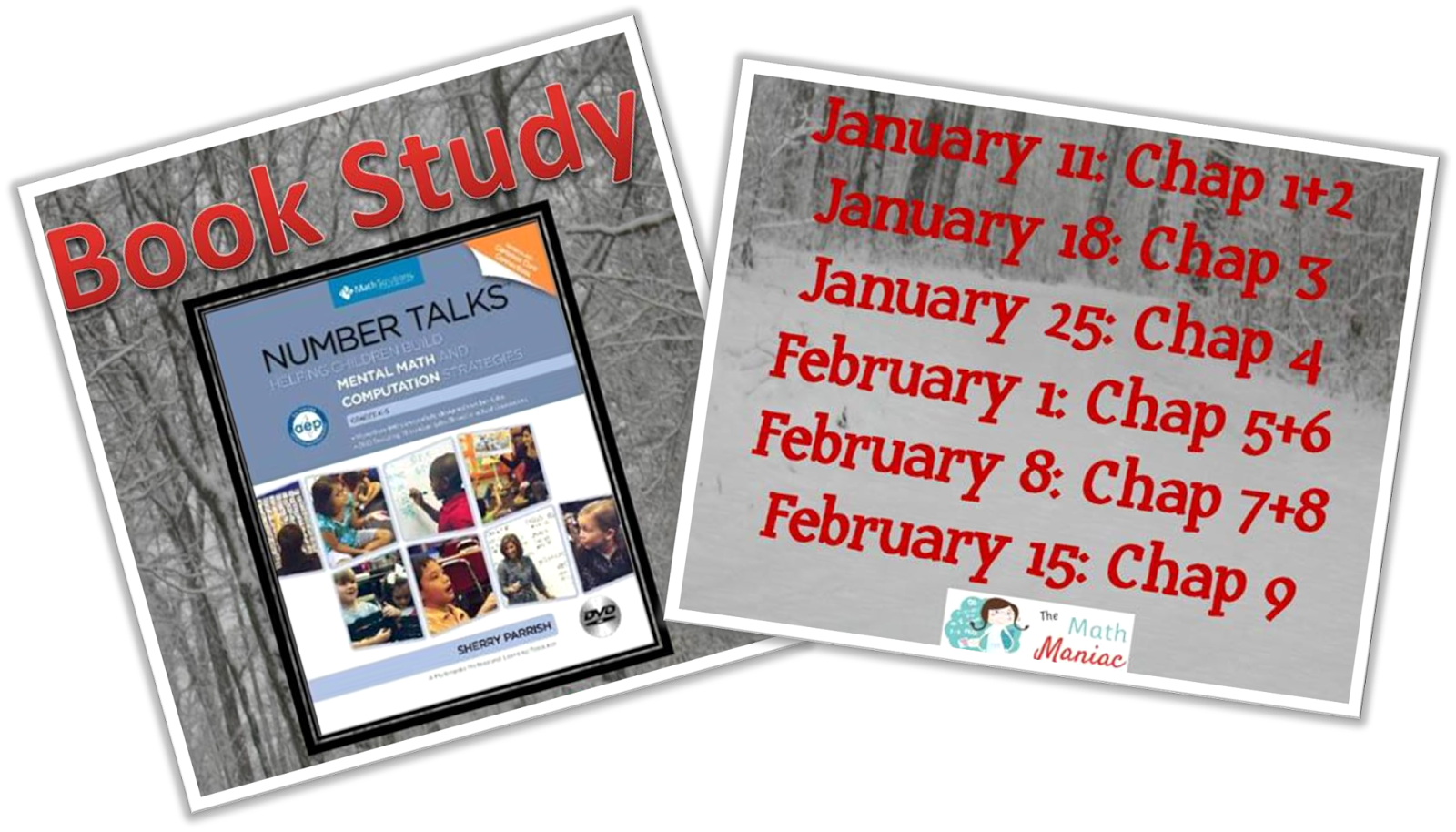
Please stop back this coming Thursday for more of chapter 2 and some free made-its.  AND thank you again to Tara, the Elementary Math Maniac, for hosting this book talk.  Head over to check out her post!  Below is a schedule for future chapters.  Hope you will continue the exploration with us!


All the best--


Friday, January 2, 2015

It's a New Year!!

It's a NEW YEAR--a Happy New Year to you!!

It's that time of year--time to celebrate and look ahead...

To help you celebrate a new year, I have created a couple of FREEBIES for you.  Enjoy my Winter Walk-About problem solving activity and Winter Friends math games.  Simply click each pic to download!

Update:  Please redownload my Winter Friends math games, as there was an error on the "In the meadow..." game board. Sorry for the error!

https://drive.google.com/file/d/0B_1w1VapXOL_OXd1WlBpZmMzcWM/view?usp=sharing

https://drive.google.com/file/d/0B_1w1VapXOL_SWtlbi0yN2hSZ1E/view?usp=sharing

AND just wanted to share a few of our blogging plans for the year ahead...

  • share new-found knowledge (for example, book studies)
  • provide a closer-look into our work with students in guided math groups
  • add read and reflect sheets for use with math mentor texts (see Resources on navigation bar)
  • continue to network with fellow math bloggers

We look forward to another great year with you!

To start it off, please feel free to join us as we participate in a new book study of, Number Talks by Sherry Parrish, sponsored by The Elementary Math Maniac.  We will do our best to keep up!  See the schedule below.


All the best to you and yours for a fabulous new year!


Wednesday, August 6, 2014

Guided Math in Action -- Chapter 9
It's the final chapter of Guided Math in Action---and it's a fabulous one at that!


In the final chapter of Guided Math in Action, Dr. Nicki shares her suggestions for rolling out the first 20 days of math workshop. In those first 20 days it is essential to help students begin to develop the eight mathematical practices that are vital in developing their mathematical proficiency. 

We will not summarize this chapter as specifically as some others---if you haven't already, we recommend you get yourself a copy of Guided Math in Action today!

Dr. Nicki suggest the first week focus on introducing students to the structure of math workshop and discussions surrounding what good mathematicians do.

Good mathematicians...
  • communicate with each other
  • talk about their ideas
  • show their work
  • write

She recommends creating anchor charts that are readily accessible for easy reference in the classroom.

Dr. Nicki suggest the second week focus on exploring routines, rules, and procedures for...
  • calendar
  • participating in number talks and mini-lessons
  • working in math centers
  • working and playing together

The third week brings with it a continued focus on working in math centers and the possible meeting of small guided math groups.

Dr. Nicki stresses the importance of reinforcing the routines associated with...
  • using manipulatives
  • playing games
  • working together

The fourth and final week should focus on what happens during debriefing.  This includes discussions related to...
  • participating in class journal discussions
  • the Mathematician's Chair (the chair where students sit to share their thoughts about math with others)
  • what is going on in the math workshop and what needs to improve 

Pages 128-133 lay out the first 20 days in chart form, and sample anchor charts are shared throughout the chapter.


Question 1
Some things I am preparing/have prepared...
  • sticky note storage sheets for recording observations
  • a simple lesson plan template to meet my needs
  • more hot topic centers
  • take home math tool bags
  • a class journal
  • some new math vocabulary centers
  • revamped calendar activities on SmartBoard
  • the list is growing...

Question 2
Some things I will continue to do...
  • create anchor charts with my students (for rules, procedures, what mathematicians do, etc.)
  • take things one step at a time--slow and deliberate
  • immerse my students in an environment of acceptance

All the best to you as you begin or continue your guided math journey this school year!

A few important tidbits...

One
A big congrats goes out to Monica R.! She was the lucky winner of Dr. Nicki Newton's Problem Solving with Models!  Thanks to all of our followers for participating!

Two
We are thrilled to be sponsoring a brand new linky---What are the other kids doing? It was inspired by chapter 8 of Guided Math in Action!  Click the image below to learn more!


Three
You MUST visit us on August 23 for a fabulous blog hop---Math Books That Will Change Your Teaching! The hop was organized by Brandi at The Research Based Classroom!


Here's how the hop will work:
  • Visit our blog and read about a HIGHLY RECOMMENDED math teaching resource.
  • Enter our drawing to win a copy of the book!
  • Hop to the next blogger, the next, and the next... to read about more fabulous math teaching resources and enter for a chance to win each of them!!
Four
This is the last day to send in your questions for Dr. Nicki Newton's second Q & A! Have questions, please send them to us at guidedmathadventures@gmail.com


Finally, we want to sincerely thank all of the bloggers and followers who participated in our first book study of Guided Math in Action. If you didn't participate, you can read all of our posts by clicking on the book cover on our sidebar. 

Smiles,