Showing posts with label blog hops. Show all posts

Saturday, February 21, 2015

Fly on the Math Teacher's Wall -- February Hop -- Fractions!!

Welcome to another wonderful math blog hop!  This blog hop is devoted to fractions and will not disappoint--so after reading this post, take a hop around to see what goodies you will find from some amazing math bloggers!


Each of our Fly on the Math Teacher's Wall hops are devoted to squashing teacher and/or student misconceptions.  I am not really discussing a misconception, but I would like to focus on some key ideas I feel most important in helping my students develop a solid foundation in fractions that will be built upon as they progress from year to year. If students understand these key ideas, hopefully some future misconceptions can be avoided.

The following is the second grade Common Core Standard for fractions:

CCSS.Math.Content.2.G.A.3
Partition circles and rectangles into two, three, or four equal shares, describe the shares using the words halves, thirds, half of, a third of, etc., and describe the whole as two halves, three thirds, four fourths. Recognize that equal shares of identical wholes need not have the same shape.

There are several key ideas for understanding:
  • A whole represents all of something (1 whole).
  • A fraction represents part of a whole (for introductory understanding, this is important--as we know, a fraction can represent any number of equal parts--as with improper fractions, but students also need to understand when working with improper fractions that an improper fraction is greater than one whole.  This understanding will be developed in later years for my students.)
  • A fraction represents part of a whole that has been divided into EQUAL parts (for my students this understanding is developed with the use of circles and rectangles, not equal sized parts of a set)

How do I help my students develop a working understanding of each of the above ideas?

We begin our explorations by identifying objects that are in the form of a whole and those that are not.  We examine items around the classroom that are and are not whole (an unsharpened pencil vs. a sharpened pencil, a unopened Kleenex box vs. a box that is part full, etc), and I also bring in various items (cookies, bottles of soda, fruits, etc.) in whole and part form.  Items are sorted into two categories.  The group of items that are not whole are then labeled as fractions.

To help students understand that a fraction represents part of a whole that has been divided into equal parts, we explore wholes that have been divided into equal and unequal parts.  A lesson about equal sharing is done.  Students seem to understand the concept of equal parts when it is related to sharing the whole of something with a friend.  Posing various sharing scenarios with items divided into equal and unequal parts is helpful.  My kids love when I choose students to share my pizza and candy bar with. I divide both unequally, share with volunteers, and then ask my students if my sharing is fair.  This naturally leads to a discussion of how my sharing is not fair because the parts I shared were not equal.  I then ask students how the items CAN be shared equally.  They, of course, can always tell me.  We continue our explorations by cutting out circles and rectangles.  We fold the shapes to create equal parts, cut them out and create models.

Only after students have a solid understanding of these three ideas do we move on to the concepts outlined in the standard.  Guided math groups are easily formed based on what I have observed in our initial explorations.  In small groups I am able to further develop some students' understandings of the key concepts before moving on, work more with some students on partitioning wholes, and challenge those who already have understanding beyond the second grade standard.

UPDATE: Totally forgot to post these little gems that I use in guided math groups.  So simple to make and use. How could I have forgotten? Enjoy!


https://drive.google.com/file/d/0B_1w1VapXOL_Z18xQjh2N2VuVlU/view?usp=sharing

Providing multiple opportunities for independent practice is always important, so this is done in rotations while I am meeting with guided groups.  Options for practice are differentiated.  Please feel free to download a few of my activities for independent practice.

Four Leaf Fractions Board Game & Spinner


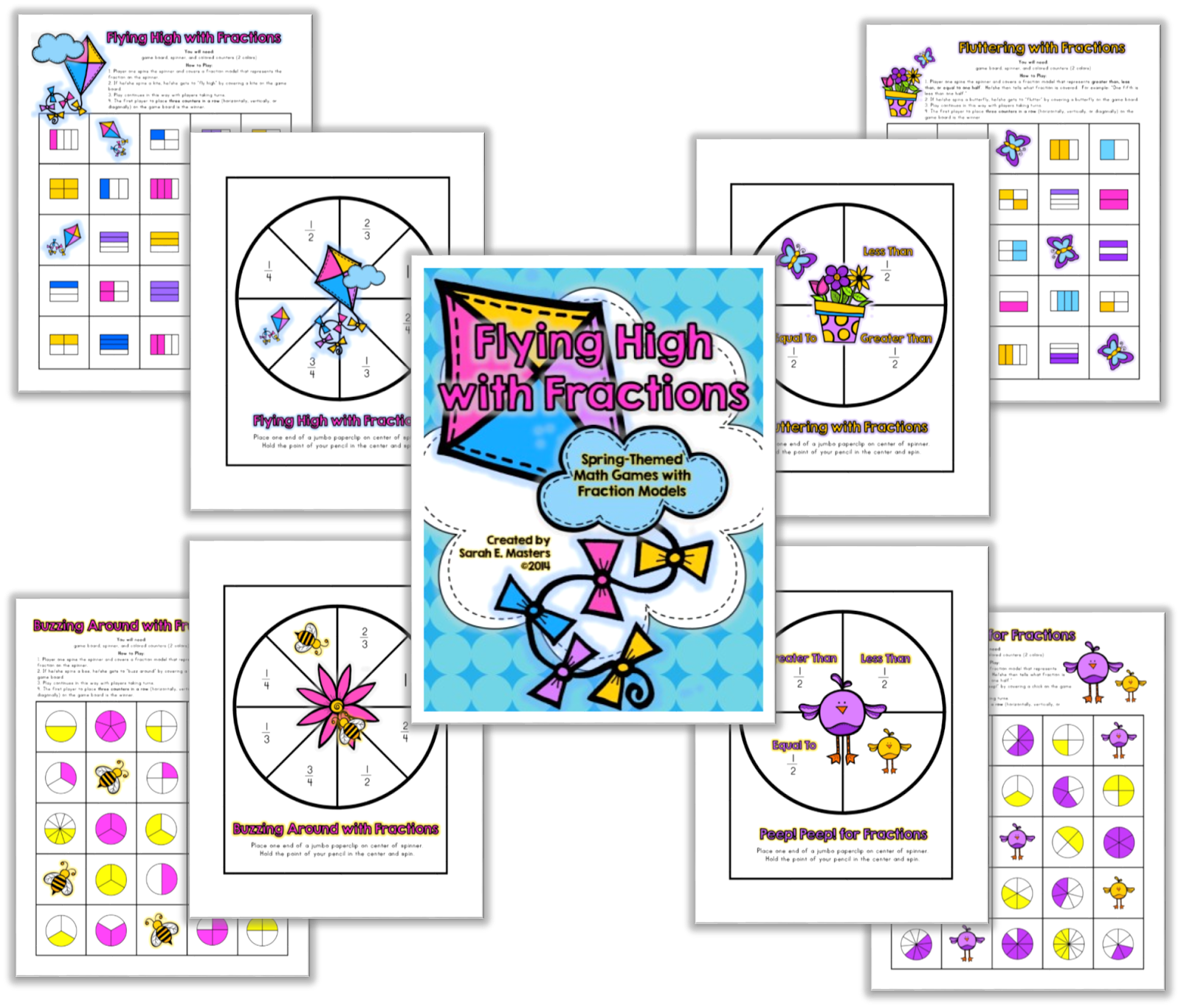
Flying High with Fractions Board Games & Spinners
https://docs.google.com/file/d/0B_1w1VapXOL_aERCRkhGT3ZYVVE/edit

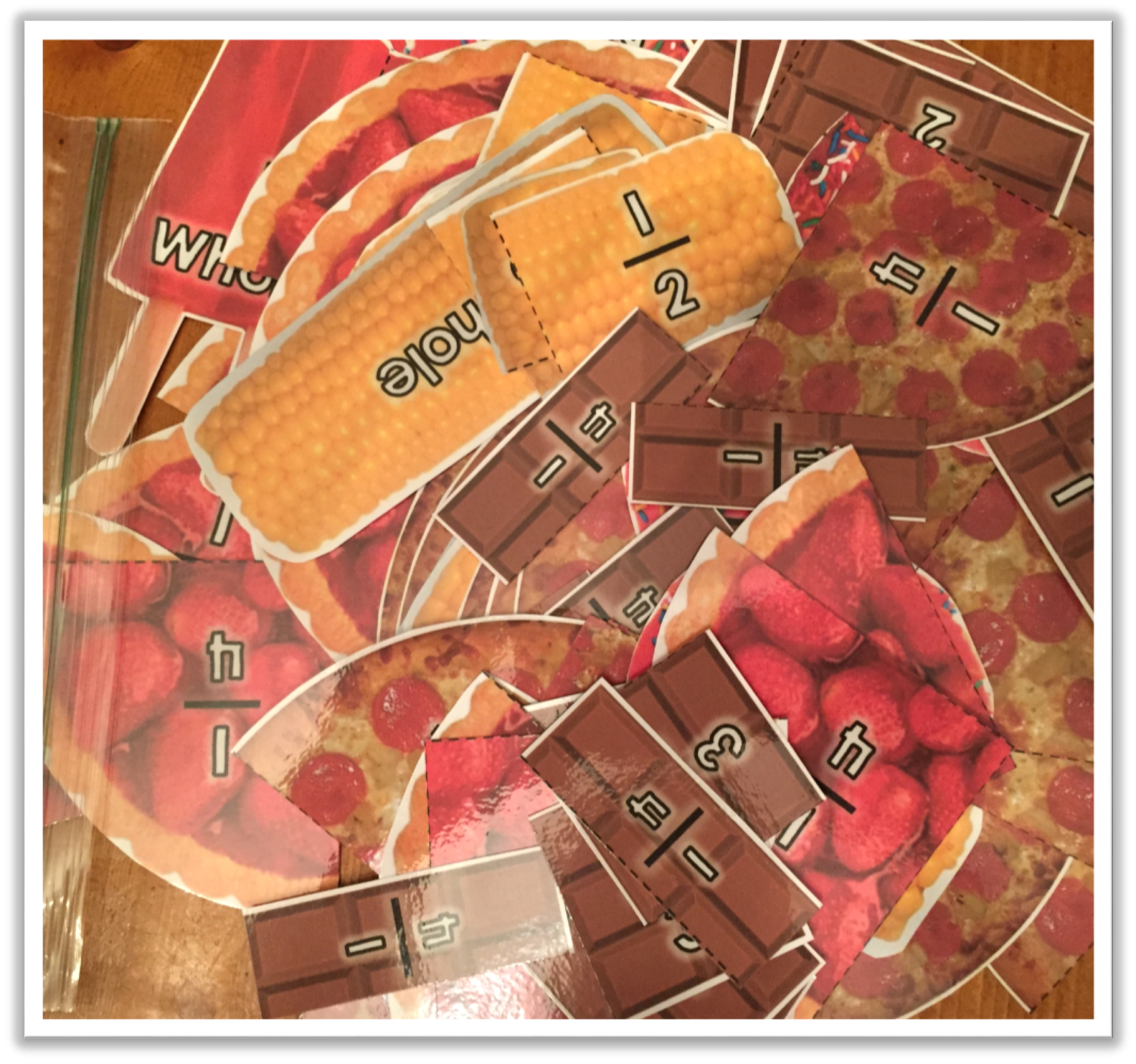
I have also made up some fraction foods you might be interested in using.  Foods are labeled and unlabeled.  These can be used in guided groups and for independent practice. I especially like to use the parts that are labled--in this way students can see that 3/4 is equal to 3, 1/4 pieces.  If you download this freebie, please take some time to share how you plan to use them by leaving a comment. Would love to hear your ideas!

https://drive.google.com/file/d/0B_1w1VapXOL_cDlvY29GREdEWmM/view?usp=sharing

Hope you have found something you can use with your students!

Please take the time to hop around to all of the participating bloggers.  Your next stop is Brandi from The Research Based Classroom!

Button

Happy hopping---

Wednesday, February 18, 2015

Number Talks Book Study -- Chapter 9

Today our book study of Number Talks by Sherry Parrish comes to a close with a brief discussion of chapter 9.


To read past book study posts, visit our Number Talks Book Study Archive

Chapter 9: What Does a Number Talk Look Like at My Grade Level?

Chapter 9 is a facilitators guided and provides a closer look at the schools/teachers highlighted in the DVD (grades K, 2, 3, and 5).

A math time structure is shared for each level and discussion questions for the videos are presented.

A school-wide perspective is also given so readers can understand the importance of consistency among number talk content from year to year even with the natural variation in personalities, classroom structures/environment, etc.

Parrish stresses the importance of/consistency in ...
  • the teaching of the big ideas in mathematics
  • instruction as asking not telling
  • the development of safe learning communities
  • an unwavering quest for making sense

Love, LOVE this closing quote from Parrish, "The mark of a master teacher is the ability to reflect on his practice."  SO TRUE! For this reason, a series of questions for personal reflection are given. 

If you have participated in this book study along with us, or have read Number Talks, you undoubtedly had many moments of personal reflection.  I have found affirmation for what I strongly believe to be true about teaching mathematics, have a new-found knowledge of the power of using the number talk structure presented in the text, and am inspired as I move forward with my students.

Even more important are the cheers I hear from my students when I say it's time for a number talk and the mathematical thinking and sharing that follows!  Thanks to Sherry Parrish for her phenomenal contribution to our profession!

Speaking of Sherry Parrish, we will announce the date of her Q & A as the day draws near, so look for a facebook shout out coming soon.


A thank you also goes out to Tara, the Elementary Math Maniac, for hosting the book study and all of our adventurers who have followed along.

Lastly--you will want to stop back this coming Sunday for another Fly on the Math Teacher's Wall Hop! The topic is fractions, so we'll see you then!


All the best--
Sarah


Saturday, October 25, 2014

You Better HOP Around!: Fly on the Math Teacher's Wall--A Math Blog Hop!

Welcome to another wonderful math blog hop!  This blog hop is devoted to place value and will not disappoint--so after reading this post, take a hop around to see what goodies you will find!


Place value--a huge topic, and such an important concept for ALL ages!

As a second grade teacher, place value is at the heart of much of our explorations in math throughout the year.  Since I cannot possibly put everything I feel to be important about place value into this post, I will focus on some MUSTs in helping my students understand place value and build a solid foundation for what will follow.

THE POWER OF 10!
We as teachers know the power of 10 in our number system and how an understanding of 10 is a ESSENTIAL for building an understanding of hundreds, thousands, and so on.  I make a point of mentioning the power of 10 to my students DAILY! Any chance I get, I recite the words, "Ha--the POWER of 10!" in a sinister witch-like cackle.  They always chime in afterward! :0)  In the beginning of the year, it's a mixed bag as far as students' understanding that 237 has 23 tens and that 23 tens is the same as 230.  I like to use various prompts for students to agree or disagree with that require their use of 10.  Here is a picture of our Bright Ideas board and the first math prompt I gave this year (the board is used for all content areas). You can see the diversity of understanding with some thumbs being in the middle to show an inability to decide.  Prompts such as these bring with them wonderful discussions and students must justify their thinking.


PLACE VALUE TOOLS!
When I say tools, I mean beans, linking cubes, straws, ten frames, base ten tools, place value arrows, place value discs, an open number line, etc.  Representing numbers in multiple ways is a MUST!

At the same time, I feel it is also important for students to understand the power of different tools as well as their limitations.  An example--from the very first day of school, we do Daily Math (includes a number of the day) as a large group (this eventually leads to work in guided math rotations).  We begin with two digit numbers and eventually progress to three digit numbers.  In the beginning we use ten frame tools (small individual ten frames) to represent numbers.  The ten frame is a familiar tool used in kindergarten and first grade, so this is a great place to begin.  As we venture into representing greater numbers, students begin to understand the limitation of using ten frames for representing and drawing ten frame models.  The tools become less efficient/appropriate in this way, so a different tool is introduced (base ten tools).  We talk about each tool, their benefits and drawbacks.  We NEVER say a tool is BAD---or that it is WRONG to use a particular tool, but I feel it is important for students to understand the differences between tools and their effectiveness/applications.  Furthermore, I never begin using a tool with students, such as base ten tools or place value discs, unless they have a conceptual understanding of each disc's value.

Tools are ALWAYS readily available for students to use during guide math rotations--they never need to ask for permission.  Tools are also housed in our guided math area for easy access during small guided math groups. Please enjoy the following freebie tools that are posted under Workstations & Games on our navigation bar.  In addition, I have shared an open number line post from our other blog, Hoots N' Hollers, that you may be interested in. Enjoy!

A Powerful Tool: The Open Number Line 

PLEASE NOTE: Courtney will be sharing a new place value tool she has just added to her classroom. Look for her post about Digiblocks in the near future!  

TALK IT!
When I say "talk it" I mean constantly talking about numbers as a composition of digits that have value.  When we add 36 and 45, we are adding 3 tens and 4 tens--6 ones and 5 ones.  We talk it!  This eventually leads to reciting our addition of place values or composing/decomposing when mentally adding .  As a kid, this is one thing that was never done, at least to my recollection.  The algorithm was the focus, and an understanding of place value and talking about digits and their values was not at the forefront. Undoubtedly, there were those that understood what was going on when using addition and subtraction algorithms at a young age, but for those of us who struggled there was a lack of conceptual understanding beyond the steps we took to solve.

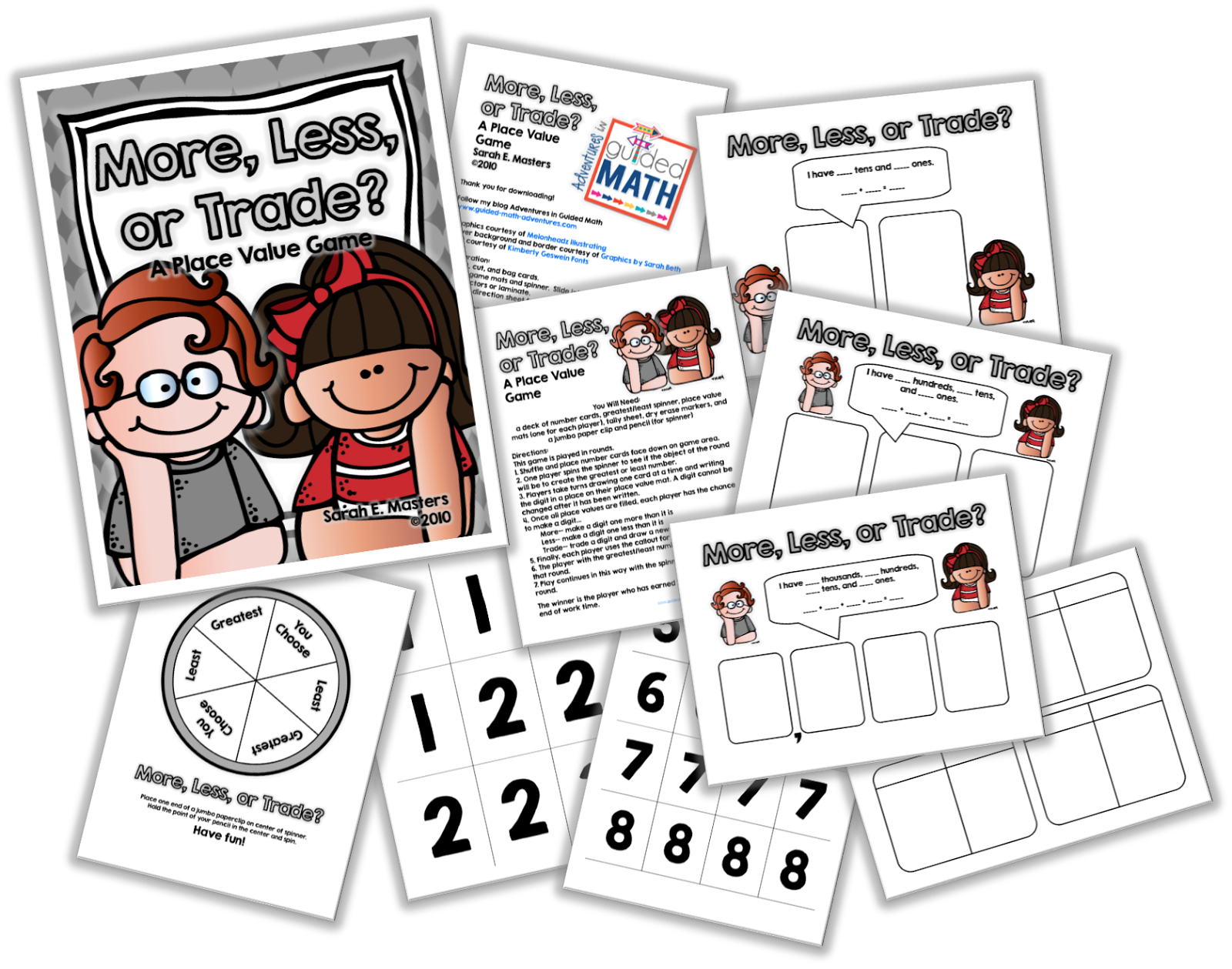
One thing I require in all place value game play is the use of callouts so that students are continually focusing on the value of each digit in a number. Feel free to download this fun place value game that my students play--More, Less, or Trade?.  Hope your kids enjoy it as much as mine have over the years!

https://drive.google.com/file/d/0B_1w1VapXOL_d1MwaGU5VVl6ZkE/view

INDEPENDENT PRACTICE!
I provide LOTS of independent place value practice for my students during guided math rotations.  Workstation games and activities are cycled throughout the year.  Place value cube activities are one of their favorites.  I have included a link where you can learn about the use of place value cubes and download directions for making your own.  There are so many possibilities for using these little buggers!


I hope you have found something that will be of use to you as you help your students develop a strong foundation.

BEFORE YOU HOP ALONG...

Feel free to sign up for the following giveaways!

The Number Line by Jeff Frykholm, Ph.D.

If you haven't already, read about using an open number line in my blog post referenced above.  Then enter to win!

a Rafflecopter giveaway

Place Value Cube Activities Pack

Enter to win some great place value cube activities that can be used in guided math groups and as workstations/centers.

http://www.teacherspayteachers.com/Product/12-Place-Value-Cube-Activities-How-to-Make-Them-773266
a Rafflecopter giveaway

Now, HOP ALONG!!  Please take the time to visit Susan at The Math Spot!

http://polkadotsandteachingtots.blogspot.com/2014/10/fly-on-math-teachers-wall-teaching.html

A thank you also goes out to Brandi from The Research Based Classroom for organizing another AWESOME blog hop!

Smiles,

Saturday, August 23, 2014

Math Books That Will Change Your Teaching BLOG HOP!

Welcome to the Math Books That Will Change Your Teaching Blog Hop! 


Get ready to hop around to all of the participating bloggers and learn about the teaching resources that have changed their teaching--resources that come HIGHLY RECOMMENDED! 


Here's how the blog hop works:
  • Read about Putting the Practices in Action by Susan O'Connel and Jon SanGiovanni.
  • Enter the rafflecopter drawing to win a copy of the book!
  • Hop to the next blogger, the next, and the next... to read about more fabulous math teaching resources and enter for a chance to win each of them!!
Here goes!  Get ready to HOP!

About the book...
  
It's important when thinking about the Common Core Standards that there are two parts--the CCSS Content Standards and the eight CCSS Standards for Mathematical Practice.  There is a huge difference between the two.  The content standards provide just that, content--they are not intended to tell a teacher HOW to teach.  On the other hand, the practice standards are intended to guide a teacher in developing ways of teaching that take students far beyond proficiency in a particular content area and help them develop as thinkers. Each of the eight Standards for Mathematical Practice are thoroughly and thoughtfully addressed in a way that helps the reader first understand the standard.  Then the authors help the reader understand "how they can get there" by providing ideas/strategies as well as student samples. 

Why did I choose this book?

Many moons ago, after I switched from a literacy coordinator to a 3rd grade classroom teacher, I attended a phenomenal math problem solving workshop presented by Susan O'Connell. In the next two years to come, I was fortunate to be able to attended two more of her workshops.  Each of her workshops strengthened my beliefs in how to teach mathematics, but ultimately they exposed me to numerous strategies to help my students develop as mathematicians--thinkers!

For this reason, I was thrilled when I discovered Putting the Practices Into Action: Implementing the Common Core Standards for Mathematical Practice, K-8.  Upon close examination, I found MANY of the strategies/ideas shared by Susan from those workshops I attended.  It was an easy choice for me when deciding what teaching resource to share because this text embodies so many of the strategies I put into action so long ago--strategies that have made me a better teacher of math and my students POWERFUL mathematical thinkers!

As you already know, the Standards for Mathematical Practice came about with the Common Core.  As you also know, these standards embody practices that are NOT NEW.  Making sense of problems and persevering in solving them, using appropriate tools, modeling with mathematics (and the remaining five practices) are, and have ALWAYS been, ways by which our students become problem solvers, reasoners, and communicators of mathematics. Yet, the Common Core has brought these practices to the forefront in an effort to establish consistency from state to state.  I have not found another text that has thoroughly addressed these practices and has offered so many activities and strategies for implementation.  Putting the Pieces Into Action does not disappoint!

Some Text Highlights!
  • a presentation of the rationale and understanding for each standard
  • classroom tested techniques
  • examples across grade
  • tips for assessment
  • specific strategies/activities for implementation

Strategies & Activities

Here are just a few of the strategies/activities I have used for years, shared by Susan in her workshops, an included in Putting the Practices Into Action.

Eliminate It! -- This is an activity that can be used with words, numbers, fractions, models, etc.  The possibilities are many.  The gist---students are given four words and they must eliminate one that does not belong with the others, and they must justify their choice. 

Headline Stories -- An equation is used as a newspaper headline story.  Students create stories (word problems) that go with the headline. 

Number Webs -- Students are given a quantity and they write it in the middle of the web.  Then they web by express the quantity in as many ways as possible.

Pinch Cards -- Cards are printed with symbols to represent select operations (+, -, x, and/or /).  Students show and pinch the operation they would use to solve given problems.

Agree or Disagree? -- A math statement is posed.  Students either agree or disagree with the statement and must provided evidence for their choice.

Number Partners -- A set of numbers is given (about 10).  Students find partners/number pairs to equal a given amount.

4-Square Word Boxes -- A concept/term is written in the middle of the box.  Students define, picture, give real-life examples, and list related words.

Something New to Try

This year, I plan to use "rich tasks" with my second graders.  In the appendix, O'Connell and SanGiovanni share examples of rich tasks for primary, intermediate, and middle school.  Rich tasks integrate most, or all, of the mathematical practices and require students to find solutions (which are many) and make judgements.  I will be sharing some of the rich tasks I use with my students in future posts. 

I strongly encourage you to to take a peek at Putting the Practices Into Action by visiting Heinemann's website.  AND don't forget to enter to win a copy!!

Now it's time to hop on over to Meg at The Teacher Studio!

http://www.theteacherstudio.com/2014/08/math-books-that-will-change-your-life.html

Thanks go out to Brandi from The Research Based Classroom for organizing this fabulous blog hop!