Showing posts with label make-its. Show all posts

Tuesday, April 14, 2015

Makin' It Math Mid-Month Linky -- April

Welcome to this month's Makin' It Math mid-month linky!  If you are a blogger, feel free to join us by adding your link at the end of this post.  Check out the details here!

http://www.guided-math-adventures.com/p/makin-it-math-mid-month-linky.html
This month, I put together two sets of task cards for measurement and geometry.  I also updated my money task cards to include QR Codes. AND since I usually include at least one freebie in my make-it posts, I will be giving away three sets! If your name is drawn, you pick the set you like best!  Just enter the rafflecopter to win...


https://www.teacherspayteachers.com/Product/2nd-Grade-Measurement-Task-Cards-Measure-It-1796703


https://www.teacherspayteachers.com/Product/2nd-Grade-Geometry-Task-Cards-2-D-Shape-Task-Cards-Polygons-1807055


https://www.teacherspayteachers.com/Product/Money-Task-Cards-Show-Me-the-Money-Differentiated-Math-Center-Cards-522227

a Rafflecopter giveaway

We hope you will share your made-its by linking up below!

All the best--

Saturday, March 14, 2015

Makin' it Math Mid-Month Linky -- March

Good day!  Thanks for stopping by for our Makin' it Math mid-month linky!
http://www.guided-math-adventures.com/p/makin-it-math-mid-month-linky.html

Wanted to share a few things that have been going on in the classroom and a few made-it to go with them...

First, we just had open house this past week and I asked my kids to reflect on their learning thus far this year with a "Glow & Grow". This is something that can be done any time during the school year.  Students simply write something they are able to do well after all of their hard work and help, and they write about something with continued effort is an area they will "grow"/improve. Loved to see some of the students' reflections about math!  Feel free to download a copy to use with your students.


Second, we explored fractions with pizzas this week.  I purchased Amy Lemons' Pizza Fractions and adapted it for my students.  We used all of the toppings and pizza template divided into fourths and added four toppings to cover one fourth, one half, three fourths, and the whole pizza.  Students began by choosing a topping to use on the whole.  Then a topping to use only on a fourth, on half, and finally three fourths.  Afterward, they completed the sheet shown below.  This really tested their understanding of equal-sized shares of a whole and how to represent fractions by adding toppings accordingly.  Not to mention, it was fun!  You can use the sheet I created with other pizza fraction activities, so snag it if you like.


Lastly, we explored fractions with foods (faux foods) this week in guided math groups.  Students are developing a solid understanding of fractions at the second grade level and LOVED using the foods.  I shared this made-it in a previous post, but I decided to share it again here.  So many possibilities for using these gems, so you will want to download them!

https://drive.google.com/file/d/0B_1w1VapXOL_Y0V6UGRaSmRoWU0/view?usp=sharing

Hope you find this month's made-it useful!  Have a blog and want to share your math-made its in a post? We would love to have you link up below!

All the best for the coming week--


Saturday, February 14, 2015

Makin' It Math Mid-Month Linky -- Money, Money, Money!

Glad you stopped by! Welcome to our Makin' It Math Mid-Month Linky--a linky dedicated solely to math made-its.  If you are interested in linking up your math made-its, check out the details by clicking the logo below.  We would love to have you join us! 

http://www.guided-math-adventures.com/p/makin-it-math-mid-month-linky.html

Our kids have been working a lot with money in the past few weeks, and are quickly becoming money masters!  We thought we would give you an inside look at our explorations and share some made-its.

Our money explorations began with a simple pretest.  Students were asked to name each coin, tell the value of each coin, and count a small selection of coins (if able).  Students were pulled to do the assessment individually with real coins while other students were engaged in math game play.  This quick assessment made it easy to group students based on need.  Four groups were formed and guided instruction of small groups began.

Small Guided Math Groups

The following have been key in our small guided groups:
  • the use of coins that students can touch/feel and manipulate
  • mastery of coin identification and values before moving on to counting (some groups moved on sooner than others and students who showed mastery quickly were worked into a different group)
  • a gradual progression in coin counting (mastery of counting like coins and adding coins from least to greatest--pennies and nickels; pennies, nickels, and dimes; pennies, nickels, dimes, and quarters)
  • multiple opportunities to count random groups of coins and write the total value using numbers and symbols (students would count a collection of coins for the group two times and the other students in the group would agree/disagree, recount to check accuracy, and discuss order in which coins were counted)
  • acceptance and discussion of multiple ways of counting (including discussion of counting on coins to create landmark tens for ease of counting remainder of coins)
  • self and peer-evaluation and justifying of thinking
  • use of the open number line to illustrate how coins were counted
  • lots and lots of practice 


Students carefully counted in their heads as their peer counted aloud.  Students then agreed or disagreed and gave proof.  Discussions of how coins were counted (order) happened here as well.


Students showed their thinking with an open number line.


Students evaluated their peers and provided justification for their thinking.  The students on the left drew faces to provide evaluation for their fellow classmates as they worked their way from desk to desk around the room.

 Students showed multiple ways to represent a dollar.

Independent Practice

The following are a few independent practice opportunities we  provided for students to work on while meeting with guided math groups (differentiated based on each group's needs and all designed for practice of money skills).  Please feel free to download any you can use.  Some were created this year and others we have used for several years.
Math Journals:

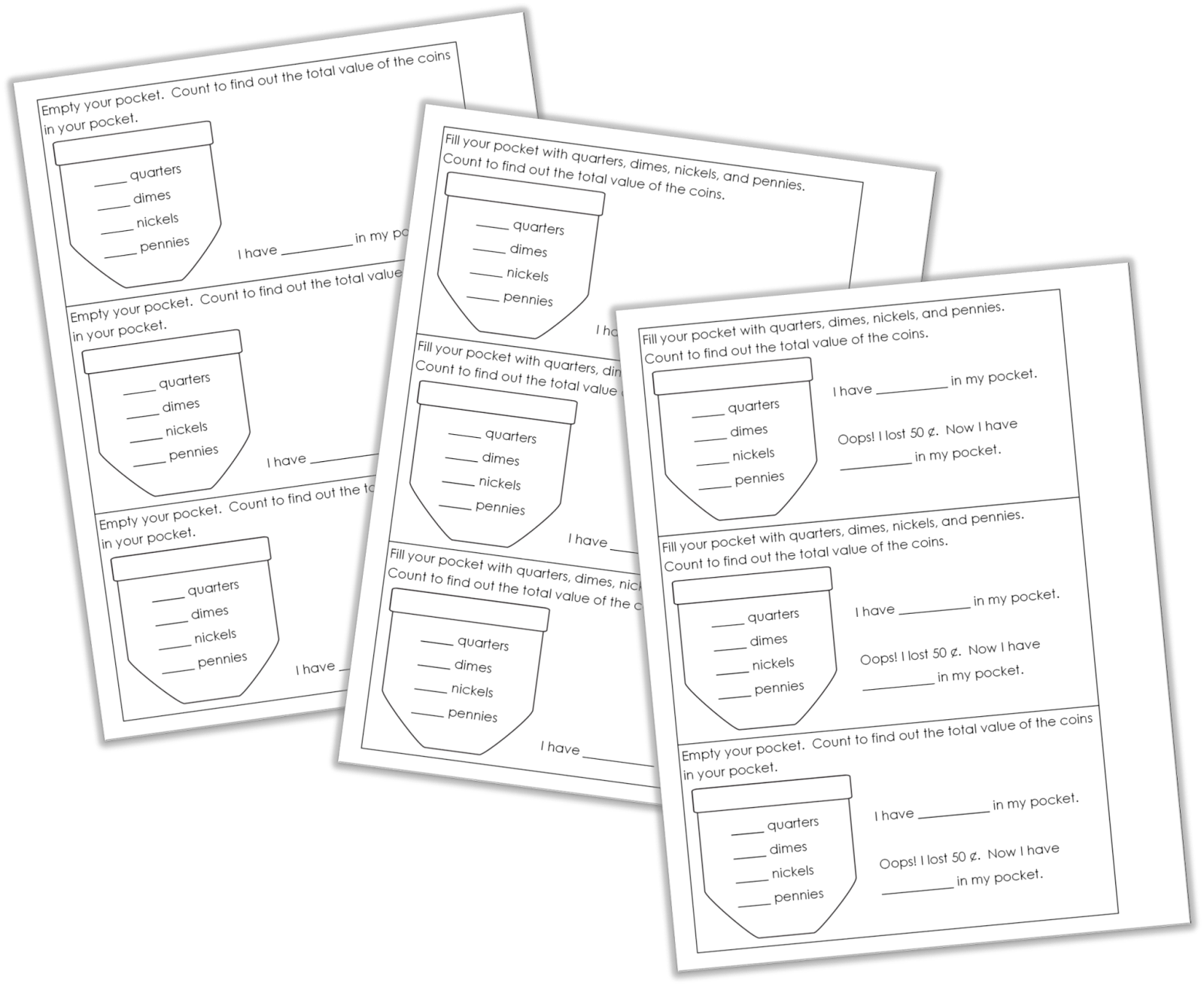
Coins in My Pocket Journal Prompts - These prompts can easily be differentiated.  My kids use half-sized notebook journals and simply cut and paste the prompts and solve.
https://drive.google.com/file/d/0B_1w1VapXOL_c3ZSeXFhZ1YyT3M/view?usp=sharing

"Show What You Know" independent tasks (premade/teacher created activity sheets, roam the room activities, Scoot activities, What's a Word Worth?, etc.) that can be used as assessment:

I don't find too many premade activity sheets that I like, but I inherited an OLD version of this workbook years ago. I think it's one of those for parents to use at home, not sure. It's great!  It follows a logical progression of practice from like coins to pennies and nickels, pennies/nickels/dimes, etc.  It also has some great problem solving sheets.  I pick and choose the sheets to use based on student need and place them in folders labeled A, B, and or C.  Cups of coins are always made available for use with these activity sheets.

What's a Word Worth?
--
I'm sure you have seen or used something like this before.  Students can use any word list and the coin key to figure out what each word is worth.  I have three different sheets made and labeled A,B, and C so students practice with the coins they can count independently.  

https://drive.google.com/file/d/0B_1w1VapXOL_dVNtN0tKTlFibWM/view?usp=sharing

Counting Coins ScootStop back to download soon!

Games:

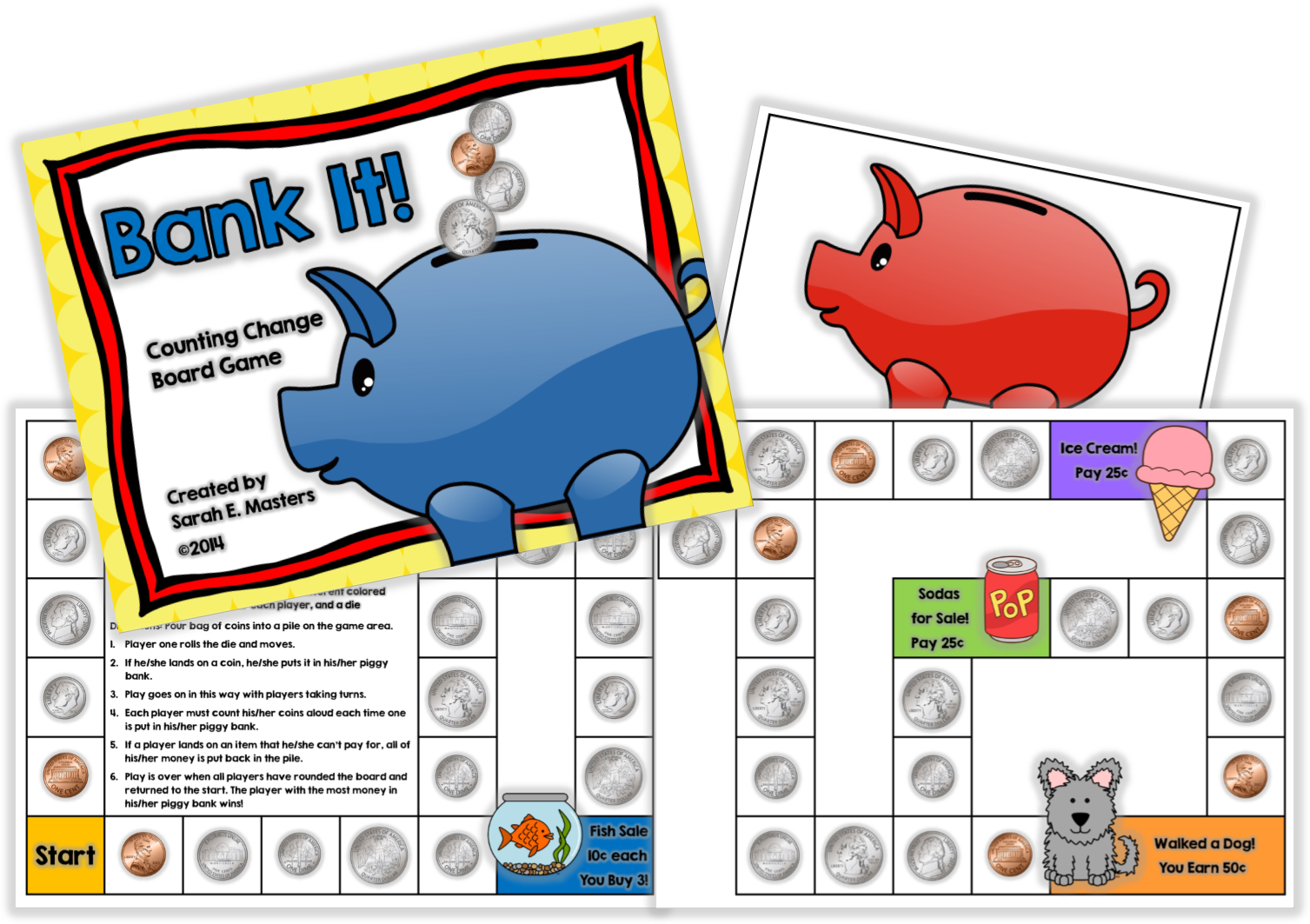
Bank It! Board Game -  This game can be played after students have learned to count pennies, nickels, dimes, and quarters.  It requires addition and subtraction of coins. My kids love this! Games like these are easy to send home for at-home practice. 


https://drive.google.com/file/d/0B_1w1VapXOL_X2p6QUNQYjJkNUk/view?usp=sharing

You may also like my This Little Piggy! Money Fun games on TpT.


Workstations (task cards, money bag activities, etc.):

Money Bags!: Coin Tasks - This differentiated workstation is used with bags of coins (fill with coins appropriate to student need).

http://www.guided-math-adventures.com/p/workstations-games_18.html
You may also like my Show Me the Money! task cards on TpT.

Assessment

Ongoing assessment is easily done in guided groups.  Much is assessed through observation.  Courtney and I also created a performance task that we use to assess students' levels of mastery.  Please feel free to download, Suzy's Piggy Bank.  If you use this task, we would love to hear your comments and thoughts about how it went.  Feel free to email us anytime!

Please share your thoughts and ideas in a comment OR link your blog post up with us!

All the best--


Wednesday, January 14, 2015

Number Talks Book Study - Chapter 2, Cont. & Makin' It Math Linky

Good day! Today's post serves two purposes---the continuation of our book study of Number Talks, by Sherry Parrish, and our mid-month Makin' It Math linky.  Therefore, make-its will be intertwined in a discussion of Chapter 2.


To read my previous Number Talks discussion of Chapter 1, and the beginning of Chapter 2, please CLICK HERE!

Chapter 2: How Do I Prepare for Number Talks, continued.

First, I would like to share how my students got prepared for number talks.  My students do A LOT of talking about math--explaining their thinking, justifying their solutions, comparing/contrasting their strategy use with that of their classmates, assessing the reasonableness of solutions--all while showing respect for their fellow classmates. BUT, I wanted to introduce my students to the Number Talk procedures outlined in the text because there were components of number talks that I had not used. I felt my students would benefit greatly from the consistency in procedures as well.

We began, as we do with anything "new", by making a list of expectations.  We did this at the beginning of the year when preparing for what we call math "chats", so I thought it fitting to do the same with number talks.  I talked to my students about how a number talk would work and asked them to generate a list of behaviors they felt would be important to show during this time. It's interesting how the first two behaviors on their list are almost directly stated from our social skills program and are quite fitting.  Loved how "think together" was put on the list.  I helped them with the word "praise" as a description of the kinds of positive things we say to one another when sharing ideas, even when there are some errors in thinking.


I also introduced the silent hand signals they would be using during number talks.  We practiced them several times before having our first "official" number talk. The signals are posted as reminders, yet they will not be needed long...  Feel free to download these simple posters by clicking the pic below.

https://drive.google.com/file/d/0B_1w1VapXOL_dVIxVHFSYTduZEU/view?usp=sharing

I felt my students were ready to go, so I had to make sure I was ready.

Chapter 2 helped to prepare me...

After sharing four procedures and expectations essential to number talks, Sherry Parrish goes on to help teachers understand how important it is to anticipate the ways students will come to a solution. She suggests thinking through the possible strategies students may use to solve a given problem.  Even if you are not able to anticipate all of the strategies students will use, preparing yourself ahead of time in this way will increase your ability to understand what is being shared during the number talk.  Parrish also stresses the importance of thinking about how you will record students' thinking so that it clearly illustrates each strategy for students.

Below you will see some pictures of how I recorded students' thinking during two different number talks.  I will be recording on the SmartBoard just as soon as my computer glitches are fixed.  This will be a nice way to store records for easy reference.  For now, I am doing it on chart paper.

I chose the problems carefully as suggested early in chapter 2.  The majority of my students' understanding of place value is strong, and many use this understanding when adding two digit number, yet I wanted the whole class to see how making a landmark or "friendly" number can work (a strategy that some students have worked with in small guided math groups). 


Would love to hear your comments about what you see recorded.  Why do you think solutions are crossed out with names written next to them in the second pic? What do you notice about Abbi's thinking from one day to the next? 

As I reflect, one of my goals will be the addition/breaking up of each place value as described in the text to illustrate the separation of each digit's value in a different way.

Example:
29 + 29
(20 + 9) + (20 + 9)
(20 + 20) + (9 + 9)

Have I said how much I love number talks already??

Moving on...

I am sure many of you thought about student accountability when reading. I did. Parrish makes six wonderful suggestions for developing students' accountability:

  • Ask students to use finger signals to indicate the most efficient strategy.
  • Keep records of problems posed and the corresponding student strategies.
  • Hold small-group number talks throughout each week.
  • Create and post class strategy charts.
  • Require students to solve an exit problem using the discussed strategies.
  • Give a weekly computation assessments.

AND--What if students still need to develop mental reasoning?  Make manipulatives accessible, and use tools such as number lines, hundred charts, rekenreks, and ten frames as appropriate for developing conceptual understanding that is foundational to mental reasoning.

Finally, Parrish suggests five small steps toward teaching for understanding:

  • Start with small problems to elicit thinking from multiple perspectives.
  • Be prepared to offer a strategy from a previous student.
  • It is all right to put a student's strategy on the back burner.
  • As a rule, limit your number talks to five to fifteen minutes.
  • Be patient with yourself and your students as you incorporate number talks into your regular math time. 

In the coming chapter readers receive support for developing specific strategies in their K-2 classrooms.  Hope you will stop back this coming Sunday for a discussion of Chapter 3! 

Now, some WONDERFUL NEWS!

Sherry Parrish, the author of Number Talks, will be doing a Q&A after the completion of our book study! We are collecting questions now, so feel free to send in any questions you have for Sherry from now up until the first week in February. We will also include a reminder in each of our book study posts. You may send questions to guidedmathadventures@gmail.com. Thanks go out to Sherry!


Last, but not least, we would love for you to leave your comments and link up any math made-its you would like to share!

Smiles,


Friday, November 14, 2014

Makin' It Math! Mid-Month Linky -- November

Welcome to November's Makin' It Math! linky! So glad you stopped by!


In the past month, I have put together some math tool bags for the kids to use at home. Tool bags were sent home after talking with parents at parent-teacher conferences in October.

************************************

The following information is posted on my classroom website for parents, but it also gives you an overview of math tool bags and how they are used at home.


What are math tool bags?

Math tool bags house various math tools, games, and activities for at-home math practice.

What is in my child's math tool bag?

Various tools/items are housed in your child's bag.  Tools may include, but are not limited to---dice, clear colored counters, place value cubes, a number line, ten frame/number cards, and paper base ten tools. Not all bags contain the same tools/items (based on student need).

What should I know about my child's tool bag?

  • Tool bags are to be kept at home in a safe place.
  • Your child should take pride in caring for his/her tools for extended use. 
  • The tools in the bag are to be used for at-home math work and games.
  • The tools should not be used in any other way (as toys, for other games, etc.)
  • Your child will be able to keep all items in his/her bag at the end of the school year (unless otherwise noted when sent home).
  • Math games sent for home practice should be kept in the math tool bag.
  • Additional items will be sent home at various times of the year and should be added to your child's tool bag.

When should my child use the items, activities, and games in his/her bag?

Your child can use the items in his/her bag for at-home math practice at ANY time.  Activity/game suggestions will be noted periodically on your child's "My Responsibilities" Sheet and materials will be sent home.  Nothing needs to be returned to class as proof of at-home practice.  It is strongly recommended that your child work with his/her bag on a regular basis.

************************************ 

The following items were sent home in everyone's math tool bag.  I have included links to various item--where they can be found and freebie printables.


Additional tools/items were sent home in tool bags depending on need.

Bags were purchased at The Library Store--See size and pricing information here!  2 gallon Ziplock bags would be less expensive and work well, too.

Periodically, I send home games/activities. Any games/activities are used in guided math groups/rotations prior to sending them home.

  • one page math games
  • spinner games
  • place value cube activities
  • dice games
  • card games
  • word problems
  • etc.

I hope you will find some of the items useful.  My kids LOVE these bags--I often hear comments about at-home activities/game play and have received positive comments from parents. :0)

Please feel free to link up your math made-its!

All the best for a wonderful weekend!


Wednesday, October 15, 2014

Makin' It Math! -- Mid-Month Linky -- {October 15}

Welcome! Thanks for stopping by for our brand-new monthly linky---Makin' It Math!  It's a linky dedicated solely to math made-its.  To learn more about the linky and how you can participate, click here!

I have been busy with several things...

Place Value Cubes

I have been making some new sets of place value cubes to start using with my kids this week.  They are so easy to make and are a fabulous tool for independent practice use while meeting with guided math groups. The best part is that you can customize them for your students' needs.  Feel free to download my free directions for making the cubes!  You can make up your own activities, or you may like the ones I have listed in my TpT store.


Low-Prep Halloween Math Games

I shared this made-it in our previous post, but this is my newest math made-it. I just finished putting a Halloween spin on some math games I have used in past years. These games are perfect for my kids' independent practice needs right now.  Thanks to Krista Wallden for her spookly clipart--so much FUN! You can check out the games in my TpT store, but you can also enter to win one of three two copies!  Good luck to you!


a Rafflecopter giveaway

Using Tens: Ten Frame Fact Cards

These ten frame fact cards really help some of my kids visualize the using ten strategy of addition before transitioning to the use of fact cards with just numbers.  Download a free copy here!

https://drive.google.com/file/d/0B_1w1VapXOL_djR5ZjRUUlFQTDA/view?usp=sharing


We hope you will consider joining us by linking up your math-made its!

Good day!


Tuesday, August 26, 2014

What are the other kids doing? ---- Problem Solving

Welcome to the third installment of our new linky--What are the other kids doing?  It's a linky dedicated to sharing independent practice activities that you use with your students that make it possible for you to meet with small guided math groups.


Today's topic is problem solving!  We will be sharing some things we already do and some new things we are looking forward to trying.


Allowing students to independently problem solve as individuals, with a partner, or in small groups is essential.  Creating the problems is something I find myself doing on a daily basis.  I do not plan ahead a week in advance---I am continually considering my students' current understanding of concepts, the skills they have learned, how they are progressing in guided math groups, and the standards.

Three different problems may be provided for students on a given day.  For example, we may be working with adding on with the start unknown. Some students are able to work with greater numbers (three-digit) while others are adding 2 digit numbers.  The problems may be identical with differing numbers.  There may also be a group of students having difficulty writing an equation to match a start unknown addition word problem.  Those students may continue working with a result unknown problem in the independent setting and further work will be done with guidance in a small guided math group with start unknown problems.  I simply number the bags that house problems so students know exactly which problem they will be solving.

Some problems include a checklist to help guide students, while others may not---this depends on the needs of students.

A checklist example:
  • Carefully read the problem.
  • Label what is known (K) and unknown (U).
  • Write an equation to match the problem situation.
  • Solve the problem using a strategy of choice.
  • Write your answer in a sentence with words.

Whatever problem students are given, one thing remains constant---students must decide what strategy they will use to solve.  The strategy (pathway) is just as important as the solution.  The discussion that students are allowed to have with one another gives them the opportunity to see multiple pathways for solving the same problem as well.

Problems do not always have one solution, and students don't always solve the problems they are given.  Here are two examples:
  • 25 trick-or-treaters went into the haunted house.  Some were brave enough to go upstairs, and the rest stayed downstairs. How many went upstairs? How many stayed downstairs?
  • 16 students went into the library.  Two students sat on each beanbag.  How many beanbags were used?  What strategy would you use to solve this problem? Be prepared to tell why you would use this strategy. 

No matter how well problems are planned, there are times when students get stuck.  Pam from Pam's Place came up with a wonderful idea to help instill perseverance in her students---Need a Hand?  Click here to read more about Pam's fabulous idea! 

Below are pictures of the hands that students will be able to use during independent work time while I am meeting with small guided math groups. 


Suggestions on hands include:
  • Use tools to model.
  • Reread the problem.
  • Try a different strategy.
  • Label what is known (K) and unknown (U).
  • Picture the problem situation in your mind.
  • Look back to your journal for a similar problem. 
  • Problem solve any words you do not understand. 
  • Draw a picture.
  • Ask yourself what you have learned that can help you.
  • Look for a pattern.
  • Act out the problem silently or with a partner.
  • Talk about the problem with a classmate. 
  • More will be added as the year progresses...

Something else I would like to try this year is group problem solving with roles.  This idea was shared in Dr. Nicki Newton's book Guided Math in Action (Chapter 8). While students work collaboratively to solve the problem, each has a special role. 

She suggest the following four roles:
  • Reader--reads the problem and translates for the group
  • Illustrator--draws a model to show the group's thinking about the problem
  • Number Cruncher--writes an equation to show the numbers in the problem 
  • Checker--Solves the problem in a different way to check the original solution

We will spend needed time understanding expectations and practicing before students are expected to work independently.

Finally, I would like to recommend a couple of great resources for problem solving---one I have had for years, and a new one.  Check them out!


I have also worked with students using model drawing (Singapore Math) as a fifth grade teacher for many years.  Here is a resource I recommend!


A few years ago I discovered these cards from Edupress. I purchased them at our local school supply store for about $10 a piece. Inside are 40 cards (front and back).


Please excuse the bad iPhone picture...I looked and looked for the grade 2 cards on websites but could only find the Addition and Subtraction cards for grades 2-3. I could only find the problem solving cards starting at grade 3. You can find those here.

What I like about these cards is that they can be done in small groups, or as a workstation. I have used them as both. One year, I had a "Brain Blaster of the Week". I would display the card and the students would try to problem solve what was on the card for that week. I had a bucket for them to put their work in. They could just use a slip of paper to show how they problem solved. That was a requirement. I wouldn't just take answers written on a slip, a strategy had to be shown. I would then draw a few papers from the bucket. If they were right, or close, using a strategy matched the problem, we would discuss it as a class. I would then give a fuzzy (part of our classroom management system). Some of the kids were baffled that someone could be rewarded for getting an answer wrong. I like to reinforce the idea that mathematicians are not always right, and need to practice, practice, practice!

I then would go through the rest of the bucket when the kids where gone, and I would assess who is on track and who needs more guidance. This was addressed duirng small guided math group times. We would break down the problem and discuss strategies that could be used to solve the problem.  These cards are a great assessment tool, too!

We would love to hear your problem solving ideas and how you use them with your students!  Feel free to link up or share in a comment!  Click here for details about linking up...

AND---If you haven't already, visit a fabulous blog hop--Math Books That Will Change Your Teaching! You can enter to win some HIGHLY RECOMMENDED math resources!!

http://www.guided-math-adventures.com/2014/08/math-books-that-will-change-your.html

Friday, July 25, 2014

Five for Friday & a Giveaway!

It's Friday and our first Five for Friday!  This week we are drawing attention to a fabulous idea shared by a blogger participating in our Guided Math in Action book study as well as some other goodies.

Our book study is in full-swing, but it's NOT too late to join in!  Click here for more details!

http://doodlebugsteaching.blogspot.com/2014/07/five-for-friday-linky-party-july-25th.html

One
Need a Hand?

http://atpamsplaceblog.blogspot.com/2014/07/guided-math-in-action-chapters-1-2.html

Pam, from Pam's Place, is participating in our Guided Math in Action book study and shared a wonderful strategy for overcoming "I'm stuck!" in math-- Need a Hand? These handy-little-hands help foster her students' perseverance. Each hand gives a tip she encourages students to try before the infamous sayings, "I need help." or "I don't get this." or "I can't do this." Pam encourages her students to TRY THREE before ASKING HER. Read more about Need a Hand?!

Two
Thinking Prompts


Guided Math in Action contains a selection of math thinking prompts to use with students. Many of the prompts are applicable to more than one discipline, and they would be great to display in the classroom.  Feel free to download the posters here!

Three
How long have you been using guided math?: Poll Results


Thanks go out to all those who participated in our first guided math poll.  We gathered 100+ votes!  The results of the first 100 votes were used to create the graph you see above.  This first poll was set up to help everyone get to know our followers a bit better.  Additional poles will be posted as time passes, and we'd love for anyone who stops by to participate. We truly hope this new blog will offer something each follower, no matter what his/her experience is with guided math.

Four
Dr. Nicki Q & A!


Another thank you goes out to all who sent in questions for Dr. Nicki's first Q & A! The questions have been sent on, and we will be posting her responses as soon as we receive them.  BUT---Remember, Dr. Nicki has generously agreed to do a second Q & A at the end of the book study as well--SO get those burning questions in! 

Here's how the Q & A will work:

  1. Send your questions to us at www.guidedmathadventures@gmail.com.
  2. We will pass your questions on to Dr. Nicki.
  3. She will do her best to answer your questions in an upcoming post.

We will be taking questions for Dr. Nick's second Q & A through Wednesday, August 6.  Anyone can ask a question!

Five
A Giveaway!

http://gigglenookmathstore.com/collections/problem-solving-books-black-white

Who doesn't love a giveaway--SO we have a great one for you---starting this Sunday, July 27!! It's a Dr. Nicki Newton, Problem Solving with Models, giveaway! Click here to check out these awesome resources! The lucky winner will get to pick the grade level resource that best fits him/her.  Stop back Sunday to read our Guided Math in Action chapter 6 post and enter to win. Good luck!

Don't forget to check out more Five for Fridays at Doodle Bugs Teaching...


Wishing you a fabulous weekend! See you back here on Sunday!