Welcome to this month's Makin' It Math mid-month linky! If you are a blogger, feel free to join us by adding your link at the end of this post. Check out the details here!
This month, I put together two sets of task cards for measurement and geometry. I also updated my money task cards to include QR Codes. AND since I usually include at least one freebie in my make-it posts, I will be giving away three sets! If your name is drawn, you pick the set you like best! Just enter the rafflecopter to win...
a Rafflecopter giveaway
We hope you will share your made-its by linking up below!
All the best--
Showing posts with label giveaways. Show all posts
Tuesday, April 14, 2015
Monday, April 6, 2015
Unifix Cubes: The Elevation of a Common Math Tool
When updating my hands-one algebra product over spring break, I was reminded of a great tip for organizing a common math tool many of us use. Several summers ago, Courtney and I attended and in-district 3-day workshop with Angela Andrews. Angela is an expert in early math and offered an abundance of useful information and strategies.
Just want to share a great tip Angela gave us for organizing a math tool many of us use with students, Unifix cubes (or linking cubes). Angela suggested not only putting Unifix cubes in groups of ten (which many of us already do), but she also suggested using two different colors to show groups of five (see picture below). The reason for this is quite simple, yet powerful.
As students progress in their understanding of number, the tools must progress with them. When Unifix cubes are separated and stored in a tub all mixed together, students who want to use them for modeling must count them one-by-one. For example, a second grader may choose Unifix cubes to represent a "situation", but when he/she has to count them individually he/she is reverting back to an earlier stage of development. By organizing cubes in groups of five (two different colors) to make up ten, that second grade student can easily see five and add on. In this way, when he/she wants to show a value such as 12, using Unifix cubes/linking cubes, the use of this tool becomes much more appropriate and efficient.
Organize cubes into groups of ten with two different colors (5 of one and 5 of another). This will eliminate one-to-one counting of cubes that may not be desired and requires students to use their understanding of 5 and 10.
I hope you find these suggestions useful!
a Rafflecopter giveaway
AND don't forget--If you haven't already checked out my book review of Fluency Through Flexibility and entered the giveaway of the materials shown below, click on the pic to do so!
Just want to share a great tip Angela gave us for organizing a math tool many of us use with students, Unifix cubes (or linking cubes). Angela suggested not only putting Unifix cubes in groups of ten (which many of us already do), but she also suggested using two different colors to show groups of five (see picture below). The reason for this is quite simple, yet powerful.
As students progress in their understanding of number, the tools must progress with them. When Unifix cubes are separated and stored in a tub all mixed together, students who want to use them for modeling must count them one-by-one. For example, a second grader may choose Unifix cubes to represent a "situation", but when he/she has to count them individually he/she is reverting back to an earlier stage of development. By organizing cubes in groups of five (two different colors) to make up ten, that second grade student can easily see five and add on. In this way, when he/she wants to show a value such as 12, using Unifix cubes/linking cubes, the use of this tool becomes much more appropriate and efficient.
Organize cubes into groups of ten with two different colors (5 of one and 5 of another). This will eliminate one-to-one counting of cubes that may not be desired and requires students to use their understanding of 5 and 10.
Here's a great
missing addend activity that was shared in the same workshop! Students
work in partners. All that is needed is a group of ten Unifix cubes
organized as shown above. One partner holds the ten Unifix cubes behind
his/her back. Then he/she makes a break and shows his/her partner
one group while keeping the other group behind his/her back. The other
partner must then tell how many cubes are hidden. He/she must
also "prove" it by counting up or back or by stating what he/she knows.
A student might
respond, "I see six, and I know there are ten altogether. I need four more to make ten with six, so four are hiding."
I hope you find these suggestions useful!
Here is the product that I was updating when reminded of this organizational system I use with my Unifix cubes. This early algebra hands-on math center requires modeling of known addends to help figure out the missing addend/s. Unifix cubes, or ten frames, can be used as show below.
Like what you see? Enter to win one of two copies of Out of this World Algebra for your students!
a Rafflecopter giveaway
AND don't forget--If you haven't already checked out my book review of Fluency Through Flexibility and entered the giveaway of the materials shown below, click on the pic to do so!
Good luck, and all the best for a wonderful week--
Wednesday, April 1, 2015
Book Review: Fluency Through Flexibility: How to Build Number Sense (Numbers 0-20)
Good day from sunny Illinois! What wonderful weather we are having here for our spring break!
Today I come to you with a book review of an outstanding teacher resource written by one of my fellow math bloggers, Christina Tondevold, The Recovering Traditionalist. Her new book is titled, Fluency Through Flexibility: How to Build Number Sense (Numbers 0-20), and it is perfect for new teachers and seasoned teachers alike.
Thank you to Christina for sending me a copy of her book and some wonderful materials to accompany the activities included. Most of all, thanks to Christina for making such a positive contribution to our profession.
In reading the introduction, I especially appreciated the background Christina provides for what fluency means when it comes to students learning addition facts. Fluency involves:
Christina goes on to stress the importance of flexibility. If students are not yet able to recall a fact, they need to use what they do know to help make the problem easier. This is something my second graders are able to do, yet it needs to be instilled in children through much exploration. An example of flexibility would be a student who cannot yet recall the sum of 8 + 9 but can use his/her current knowledge of number to create relationships between numbers. He/she might choose to:
When a student has flexibility, he/she is able to think in this way. Without flexibility, Christina stresses, students will "revert back to counting on fingers."
Number sense is SO much more than simply memorizing basic facts. This book will help you provide valuable experience for your students to explore numbers and discover relationships that lie within. Activities are organized into four areas, and these areas coincide with what students who have good number sense understand.
They understand:
Christina provides a detailed description of each of the above areas in her introduction, and goes on to give suggestions for using the activities included.
Various tools are also used with the activities and some can be downloaded or purchased on Christina's website, Mathematically Minded. Tools include subitizing cards, number paths, and the MathRack (rekenrek). It would be well worth your time to investigate Christina's rationale for using a number path vs. a number line for kindergarten and first grade students.
What do I like about this book?
How will I use this book? As a teacher who uses guided math, I can pull various activities from this book to use in small guided groups based on need, and the activities can also be done independently during station work. I did not have Christina's book at the beginning of the year, so it will be a wonderful added resource as I help my new second graders develop fluency through flexibility.
What have I tried? My second graders explored one of the part-part-whole activities, Number Search (Numbers 11 to 20). I presented the activity one way with two game boards (one for each player) in plastic sleeves using dry erase markers. Students wrote a sum in the center of the game board and each took turns circling addends to add to the sum while saying the combination aloud, "10 plus 3 equals 13." The player with the most combinations circled was the winner. Natural questions arose. "Can we overlap?", "What about the other person who can see what you just circled?", "If the sum is 19, you can't hardly circle anything.", etc. Their questions and suggestions led to some variations in game play that they created. They tried using one game board with two colors of markers, and they definitely wanted to overlap. Sums that yielded fewer combinations became games where three addends could be circled. The kids loved it! Number Search is also an activity I will be sending with the kids for at-home practice along with their math tool bags.
Do you like what you've read? Well, you can enter to win a copy of Fluency Through Flexibility, a MathRack, and Savvy Subitizing Cards--all donated by the author! How do you earn the most entries into this giveaway? Share your thoughts about Christina's new book in a comment--What sparked your interest?, What do you like?, How could you use it?, etc. Good luck!
a Rafflecopter giveaway
Keep in touch with Christina, her publications/materials, and professional development opportunities on her blog and website:
The Recovering Traditionalist
Mathematically Minded
Also--don't miss Christina's free webinar this coming Wednesday, April 8th. Click here to register!
AND, in the spirit of giving, the Easter Bunny has arrived early with a FREEBIE for you! Feel free to download this fun jellybean math activity Courtney created to use with her kids this year--Jellybean Taste-Off: Jellybean Math Fun! Simply click the pic to download!
Happy Easter to you and yours!
Today I come to you with a book review of an outstanding teacher resource written by one of my fellow math bloggers, Christina Tondevold, The Recovering Traditionalist. Her new book is titled, Fluency Through Flexibility: How to Build Number Sense (Numbers 0-20), and it is perfect for new teachers and seasoned teachers alike.
Thank you to Christina for sending me a copy of her book and some wonderful materials to accompany the activities included. Most of all, thanks to Christina for making such a positive contribution to our profession.
In reading the introduction, I especially appreciated the background Christina provides for what fluency means when it comes to students learning addition facts. Fluency involves:
- Efficiency - a speedy way to get the answer
- Accuracy - getting the right answer
- Flexibility - having another way to approach a problem when it can't be figured out
Christina goes on to stress the importance of flexibility. If students are not yet able to recall a fact, they need to use what they do know to help make the problem easier. This is something my second graders are able to do, yet it needs to be instilled in children through much exploration. An example of flexibility would be a student who cannot yet recall the sum of 8 + 9 but can use his/her current knowledge of number to create relationships between numbers. He/she might choose to:
- use doubles, "I know 8 + 8. That's 16. 9 is just one more than 8, so 8 + 9 is 17."
- use tens, "Well, one more than 9 is ten, so I can move one from 8 to make a ten. Then 10 + 7 is 17."
- create landmark/benchmark or "friendly" addends, "I can think 8 + 10, and that's 18. 18 - 1 = 17."
When a student has flexibility, he/she is able to think in this way. Without flexibility, Christina stresses, students will "revert back to counting on fingers."
Number sense is SO much more than simply memorizing basic facts. This book will help you provide valuable experience for your students to explore numbers and discover relationships that lie within. Activities are organized into four areas, and these areas coincide with what students who have good number sense understand.
They understand:
- Spacial relationships - recognizing how many without counting (subitizing)
- One and two more, one and two less - knowing which numbers are one and two less or more than a given number
- Benchmark of 5 and 10 - knowing how numbers relate to 5 and 10
- Part-Part-Whole - seeing numbers as being made up of two or more parts
Christina provides a detailed description of each of the above areas in her introduction, and goes on to give suggestions for using the activities included.
Various tools are also used with the activities and some can be downloaded or purchased on Christina's website, Mathematically Minded. Tools include subitizing cards, number paths, and the MathRack (rekenrek). It would be well worth your time to investigate Christina's rationale for using a number path vs. a number line for kindergarten and first grade students.
What do I like about this book?
- Christina's introduction that provides sound rationale for using the activities included
- the variety of activities for use with students at different stages of development
- suggestion for what to "Look For" when observing students work within an activity
- suggestions for "Reuse" depending on how students are developing
- the adaptations/extensions that can be made to activities based on student need
How will I use this book? As a teacher who uses guided math, I can pull various activities from this book to use in small guided groups based on need, and the activities can also be done independently during station work. I did not have Christina's book at the beginning of the year, so it will be a wonderful added resource as I help my new second graders develop fluency through flexibility.
What have I tried? My second graders explored one of the part-part-whole activities, Number Search (Numbers 11 to 20). I presented the activity one way with two game boards (one for each player) in plastic sleeves using dry erase markers. Students wrote a sum in the center of the game board and each took turns circling addends to add to the sum while saying the combination aloud, "10 plus 3 equals 13." The player with the most combinations circled was the winner. Natural questions arose. "Can we overlap?", "What about the other person who can see what you just circled?", "If the sum is 19, you can't hardly circle anything.", etc. Their questions and suggestions led to some variations in game play that they created. They tried using one game board with two colors of markers, and they definitely wanted to overlap. Sums that yielded fewer combinations became games where three addends could be circled. The kids loved it! Number Search is also an activity I will be sending with the kids for at-home practice along with their math tool bags.
Do you like what you've read? Well, you can enter to win a copy of Fluency Through Flexibility, a MathRack, and Savvy Subitizing Cards--all donated by the author! How do you earn the most entries into this giveaway? Share your thoughts about Christina's new book in a comment--What sparked your interest?, What do you like?, How could you use it?, etc. Good luck!
a Rafflecopter giveaway
Keep in touch with Christina, her publications/materials, and professional development opportunities on her blog and website:
The Recovering Traditionalist
Mathematically Minded
Also--don't miss Christina's free webinar this coming Wednesday, April 8th. Click here to register!
AND, in the spirit of giving, the Easter Bunny has arrived early with a FREEBIE for you! Feel free to download this fun jellybean math activity Courtney created to use with her kids this year--Jellybean Taste-Off: Jellybean Math Fun! Simply click the pic to download!
Happy Easter to you and yours!
Saturday, October 25, 2014
You Better HOP Around!: Fly on the Math Teacher's Wall--A Math Blog Hop!
Welcome to another wonderful math blog hop! This blog hop is devoted to place value and will not disappoint--so after reading this post, take a hop around to see what goodies you will find!
Place value--a huge topic, and such an important concept for ALL ages!
As a second grade teacher, place value is at the heart of much of our explorations in math throughout the year. Since I cannot possibly put everything I feel to be important about place value into this post, I will focus on some MUSTs in helping my students understand place value and build a solid foundation for what will follow.
THE POWER OF 10!
We as teachers know the power of 10 in our number system and how an understanding of 10 is a ESSENTIAL for building an understanding of hundreds, thousands, and so on. I make a point of mentioning the power of 10 to my students DAILY! Any chance I get, I recite the words, "Ha--the POWER of 10!" in a sinister witch-like cackle. They always chime in afterward! :0) In the beginning of the year, it's a mixed bag as far as students' understanding that 237 has 23 tens and that 23 tens is the same as 230. I like to use various prompts for students to agree or disagree with that require their use of 10. Here is a picture of our Bright Ideas board and the first math prompt I gave this year (the board is used for all content areas). You can see the diversity of understanding with some thumbs being in the middle to show an inability to decide. Prompts such as these bring with them wonderful discussions and students must justify their thinking.
PLACE VALUE TOOLS!
When I say tools, I mean beans, linking cubes, straws, ten frames, base ten tools, place value arrows, place value discs, an open number line, etc. Representing numbers in multiple ways is a MUST!
At the same time, I feel it is also important for students to understand the power of different tools as well as their limitations. An example--from the very first day of school, we do Daily Math (includes a number of the day) as a large group (this eventually leads to work in guided math rotations). We begin with two digit numbers and eventually progress to three digit numbers. In the beginning we use ten frame tools (small individual ten frames) to represent numbers. The ten frame is a familiar tool used in kindergarten and first grade, so this is a great place to begin. As we venture into representing greater numbers, students begin to understand the limitation of using ten frames for representing and drawing ten frame models. The tools become less efficient/appropriate in this way, so a different tool is introduced (base ten tools). We talk about each tool, their benefits and drawbacks. We NEVER say a tool is BAD---or that it is WRONG to use a particular tool, but I feel it is important for students to understand the differences between tools and their effectiveness/applications. Furthermore, I never begin using a tool with students, such as base ten tools or place value discs, unless they have a conceptual understanding of each disc's value.
Tools are ALWAYS readily available for students to use during guide math rotations--they never need to ask for permission. Tools are also housed in our guided math area for easy access during small guided math groups. Please enjoy the following freebie tools that are posted under Workstations & Games on our navigation bar. In addition, I have shared an open number line post from our other blog, Hoots N' Hollers, that you may be interested in. Enjoy!
TALK IT!
When I say "talk it" I mean constantly talking about numbers as a composition of digits that have value. When we add 36 and 45, we are adding 3 tens and 4 tens--6 ones and 5 ones. We talk it! This eventually leads to reciting our addition of place values or composing/decomposing when mentally adding . As a kid, this is one thing that was never done, at least to my recollection. The algorithm was the focus, and an understanding of place value and talking about digits and their values was not at the forefront. Undoubtedly, there were those that understood what was going on when using addition and subtraction algorithms at a young age, but for those of us who struggled there was a lack of conceptual understanding beyond the steps we took to solve.
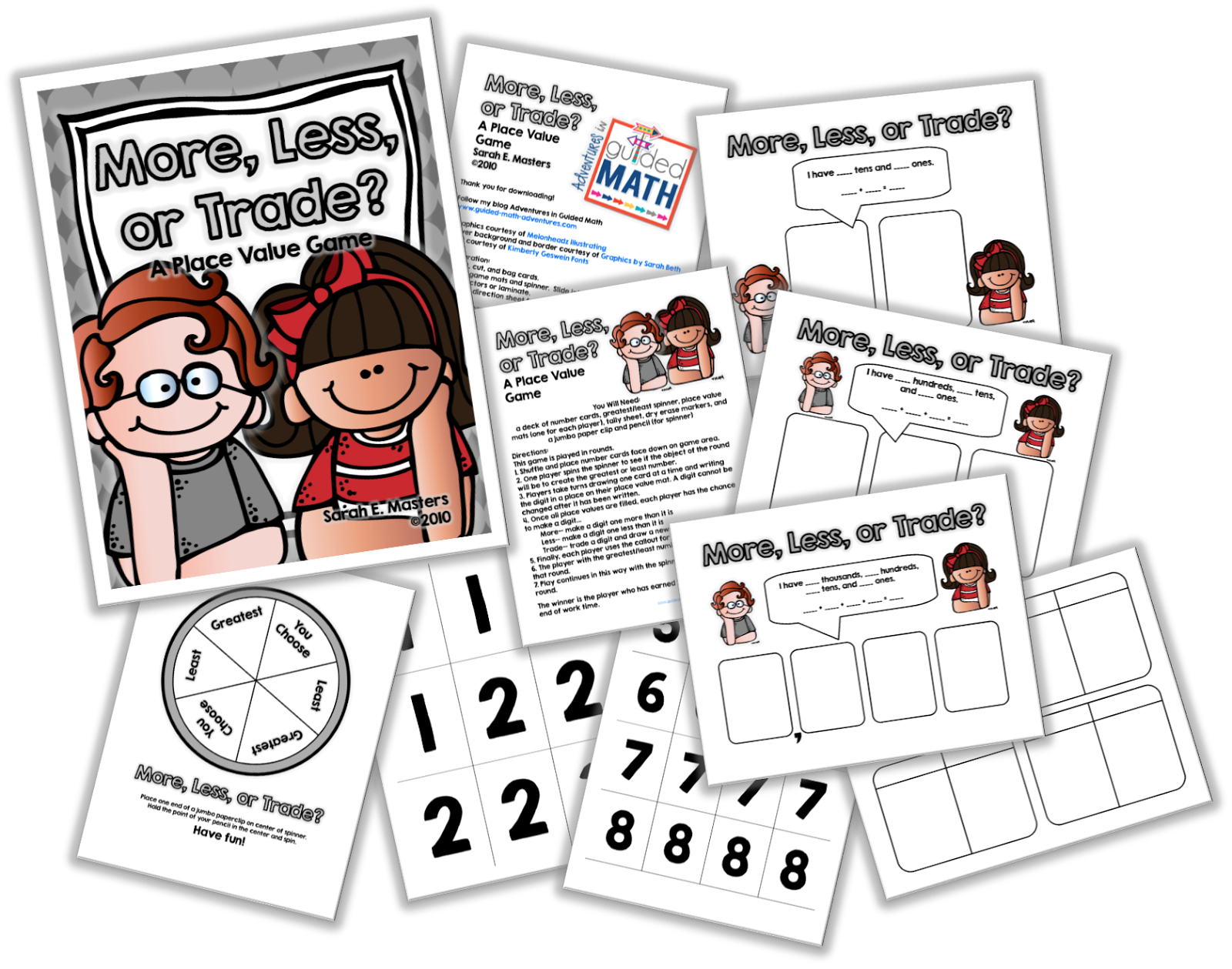
One thing I require in all place value game play is the use of callouts so that students are continually focusing on the value of each digit in a number. Feel free to download this fun place value game that my students play--More, Less, or Trade?. Hope your kids enjoy it as much as mine have over the years!
INDEPENDENT PRACTICE!
I provide LOTS of independent place value practice for my students during guided math rotations. Workstation games and activities are cycled throughout the year. Place value cube activities are one of their favorites. I have included a link where you can learn about the use of place value cubes and download directions for making your own. There are so many possibilities for using these little buggers!
I hope you have found something that will be of use to you as you help your students develop a strong foundation.
BEFORE YOU HOP ALONG...
Feel free to sign up for the following giveaways!
If you haven't already, read about using an open number line in my blog post referenced above. Then enter to win!
a Rafflecopter giveaway
Now, HOP ALONG!! Please take the time to visit Susan at The Math Spot!
A thank you also goes out to Brandi from The Research Based Classroom for organizing another AWESOME blog hop!
Smiles,
Place value--a huge topic, and such an important concept for ALL ages!
As a second grade teacher, place value is at the heart of much of our explorations in math throughout the year. Since I cannot possibly put everything I feel to be important about place value into this post, I will focus on some MUSTs in helping my students understand place value and build a solid foundation for what will follow.
THE POWER OF 10!
We as teachers know the power of 10 in our number system and how an understanding of 10 is a ESSENTIAL for building an understanding of hundreds, thousands, and so on. I make a point of mentioning the power of 10 to my students DAILY! Any chance I get, I recite the words, "Ha--the POWER of 10!" in a sinister witch-like cackle. They always chime in afterward! :0) In the beginning of the year, it's a mixed bag as far as students' understanding that 237 has 23 tens and that 23 tens is the same as 230. I like to use various prompts for students to agree or disagree with that require their use of 10. Here is a picture of our Bright Ideas board and the first math prompt I gave this year (the board is used for all content areas). You can see the diversity of understanding with some thumbs being in the middle to show an inability to decide. Prompts such as these bring with them wonderful discussions and students must justify their thinking.
PLACE VALUE TOOLS!
When I say tools, I mean beans, linking cubes, straws, ten frames, base ten tools, place value arrows, place value discs, an open number line, etc. Representing numbers in multiple ways is a MUST!
At the same time, I feel it is also important for students to understand the power of different tools as well as their limitations. An example--from the very first day of school, we do Daily Math (includes a number of the day) as a large group (this eventually leads to work in guided math rotations). We begin with two digit numbers and eventually progress to three digit numbers. In the beginning we use ten frame tools (small individual ten frames) to represent numbers. The ten frame is a familiar tool used in kindergarten and first grade, so this is a great place to begin. As we venture into representing greater numbers, students begin to understand the limitation of using ten frames for representing and drawing ten frame models. The tools become less efficient/appropriate in this way, so a different tool is introduced (base ten tools). We talk about each tool, their benefits and drawbacks. We NEVER say a tool is BAD---or that it is WRONG to use a particular tool, but I feel it is important for students to understand the differences between tools and their effectiveness/applications. Furthermore, I never begin using a tool with students, such as base ten tools or place value discs, unless they have a conceptual understanding of each disc's value.
Tools are ALWAYS readily available for students to use during guide math rotations--they never need to ask for permission. Tools are also housed in our guided math area for easy access during small guided math groups. Please enjoy the following freebie tools that are posted under Workstations & Games on our navigation bar. In addition, I have shared an open number line post from our other blog, Hoots N' Hollers, that you may be interested in. Enjoy!
A Powerful Tool: The Open Number Line
PLEASE NOTE: Courtney will be sharing a new place value tool she has just added to her classroom. Look for her post about Digiblocks in the near future!
TALK IT!
When I say "talk it" I mean constantly talking about numbers as a composition of digits that have value. When we add 36 and 45, we are adding 3 tens and 4 tens--6 ones and 5 ones. We talk it! This eventually leads to reciting our addition of place values or composing/decomposing when mentally adding . As a kid, this is one thing that was never done, at least to my recollection. The algorithm was the focus, and an understanding of place value and talking about digits and their values was not at the forefront. Undoubtedly, there were those that understood what was going on when using addition and subtraction algorithms at a young age, but for those of us who struggled there was a lack of conceptual understanding beyond the steps we took to solve.
One thing I require in all place value game play is the use of callouts so that students are continually focusing on the value of each digit in a number. Feel free to download this fun place value game that my students play--More, Less, or Trade?. Hope your kids enjoy it as much as mine have over the years!
INDEPENDENT PRACTICE!
I provide LOTS of independent place value practice for my students during guided math rotations. Workstation games and activities are cycled throughout the year. Place value cube activities are one of their favorites. I have included a link where you can learn about the use of place value cubes and download directions for making your own. There are so many possibilities for using these little buggers!
I hope you have found something that will be of use to you as you help your students develop a strong foundation.
BEFORE YOU HOP ALONG...
Feel free to sign up for the following giveaways!
The Number Line by Jeff Frykholm, Ph.D.
If you haven't already, read about using an open number line in my blog post referenced above. Then enter to win!
a Rafflecopter giveaway
Place Value Cube Activities Pack
Enter to win some great place value cube activities that can be used in guided math groups and as workstations/centers.
Now, HOP ALONG!! Please take the time to visit Susan at The Math Spot!
A thank you also goes out to Brandi from The Research Based Classroom for organizing another AWESOME blog hop!
Smiles,
Wednesday, October 15, 2014
Makin' It Math! -- Mid-Month Linky -- {October 15}
Welcome! Thanks for stopping by for our brand-new monthly linky---Makin' It Math! It's a linky dedicated solely to math made-its. To learn more about the linky and how you can participate, click here!
I have been busy with several things...
I have been making some new sets of place value cubes to start using with my kids this week. They are so easy to make and are a fabulous tool for independent practice use while meeting with guided math groups. The best part is that you can customize them for your students' needs. Feel free to download my free directions for making the cubes! You can make up your own activities, or you may like the ones I have listed in my TpT store.
I shared this made-it in our previous post, but this is my newest math made-it. I just finished putting a Halloween spin on some math games I have used in past years. These games are perfect for my kids' independent practice needs right now. Thanks to Krista Wallden for her spookly clipart--so much FUN! You can check out the games in my TpT store, but you can also enter to win one of three two copies! Good luck to you!
a Rafflecopter giveaway
Using Tens: Ten Frame Fact Cards
These ten frame fact cards really help some of my kids visualize the using ten strategy of addition before transitioning to the use of fact cards with just numbers. Download a free copy here!
We hope you will consider joining us by linking up your math-made its!
Good day!
I have been busy with several things...
Place Value Cubes
I have been making some new sets of place value cubes to start using with my kids this week. They are so easy to make and are a fabulous tool for independent practice use while meeting with guided math groups. The best part is that you can customize them for your students' needs. Feel free to download my free directions for making the cubes! You can make up your own activities, or you may like the ones I have listed in my TpT store.
Low-Prep Halloween Math Games
I shared this made-it in our previous post, but this is my newest math made-it. I just finished putting a Halloween spin on some math games I have used in past years. These games are perfect for my kids' independent practice needs right now. Thanks to Krista Wallden for her spookly clipart--so much FUN! You can check out the games in my TpT store, but you can also enter to win one of three two copies! Good luck to you!
a Rafflecopter giveaway
Using Tens: Ten Frame Fact Cards
These ten frame fact cards really help some of my kids visualize the using ten strategy of addition before transitioning to the use of fact cards with just numbers. Download a free copy here!
We hope you will consider joining us by linking up your math-made its!
Good day!
Monday, October 13, 2014
Loved that Lesson Linky and Some Other Goodies...
This is the first time linking up with Meg from The Teacher Studio for Loved That Lesson--a wonderful linky opportunity to share those lessons we love.
One of the lessons I love to do with my kids at the beginning of each new school year relates to being mathematicians. We always start by reading and defining the word mathematician, which is usually a new one for them. Then we begin to think like mathematicians and ask ourselves what we do when we doing math. This year my kids came up with a FANTABULOUS list of ideas given the simple prompt, We are MATHEMATICIANS! We... Ideas were recorded on the SmartBoard and a door display was created to remain up all year long. These can readily be seen for easy reference.
I was so pleased with their thinking!
To read about more "loved" lessons, stop on over to The Teacher Studio!
I also wanted to share a few goodies that may be of interest to you...
Fly on over to Teaching Math By Hart for a wonderful giveaway opportunity and help Kim celebrate 1000 TpT followers!
I just finished putting a Halloween spin on some math games I have used in past years. These games are perfect for my kids' independent practice needs right now. Thanks to Krista Wallden for her wonderful clipart--so FUN! You can check out the games in my TpT store, but you can also enter to win one of three two copies! Good luck to you!
a Rafflecopter giveaway
New Linky on the Horizon!
Lastly, we have a new monthly linky on the horizon that will kick-off this week--Makin' It Math! We hope it will bring along with it some wonderful math resources for many. Stop back this Wednesday!
Wishing you the best for a wonderful week!
One of the lessons I love to do with my kids at the beginning of each new school year relates to being mathematicians. We always start by reading and defining the word mathematician, which is usually a new one for them. Then we begin to think like mathematicians and ask ourselves what we do when we doing math. This year my kids came up with a FANTABULOUS list of ideas given the simple prompt, We are MATHEMATICIANS! We... Ideas were recorded on the SmartBoard and a door display was created to remain up all year long. These can readily be seen for easy reference.
I was so pleased with their thinking!
We are mathematicians! We...
- think.
- try different ways.
- have fun with math.
- work together.
- use tools.
- learn more every day.
- never give up.
- sometimes make mistakes.
- check and re-check.
- have really smart brains.
- are problem solvers.
- ask questions.
- need tons of education.
- study math.
- get stuck.
- use our brains.
- have good test scores.
To read about more "loved" lessons, stop on over to The Teacher Studio!
I also wanted to share a few goodies that may be of interest to you...
Teaching Math by Hart TpT 1000 Followers Giveaway
Fly on over to Teaching Math By Hart for a wonderful giveaway opportunity and help Kim celebrate 1000 TpT followers!
Low-Prep Halloween Math Games
I just finished putting a Halloween spin on some math games I have used in past years. These games are perfect for my kids' independent practice needs right now. Thanks to Krista Wallden for her wonderful clipart--so FUN! You can check out the games in my TpT store, but you can also enter to win one of three two copies! Good luck to you!
a Rafflecopter giveaway
New Linky on the Horizon!
Wishing you the best for a wonderful week!
Wednesday, September 24, 2014
What are the other kids doing? Wednesday Linky -- Task Cards
Welcome! What are the other kids doing? It's a linky dedicated to sharing independent practice activities that you use with
your students that make it possible for you to meet with small guided
math groups. Many teachers call them math centers or
workstations--whatever you call them, these activities are designed to
engage students in meaningful practice away from the teacher. For details about linking up, click here! We'd love for you to join in the sharing!
Today's topic--Task Cards!
Sorry for the quick post today--just want to share some freebies, a giveaway, and some new task cards I have added to my collection to use this year.
When I think about the abundance of independent activities I have for kids to do during guided math rotations, task cards make up quite a small portion. I have created some to meet my student's needs that are differentiated, but I have not been able to find a lot out there that "fit" my needs--even though there are oodles of them. I have plans to create more, but as we teachers know--so many things and so little time...
With this being said, when I do use task cards I always provide an activity sheet and a self-checking answer sheet. If one is not provided with task cards purchased, I create one. I also organize all task cards on binding rings for ease of access/to keep them together, and they are placed in workstation drawers according to student need.
My Show Me the Money! task cards are some of the kids' favorites, and they are differentiated. You can check them out in my TpT store, but you can also enter below to win one of two copies!
a Rafflecopter giveaway
You may also like the following freebies listed under Workstations & Games on our navigation bar...
AND Addition with Models & Numbers Task Cards. They are FREE, too!
Finally, here are a few task cards created by others that I have purchased and plan to use this year.
Please feel free to share your task card ideas in a comment or link up!
Today's topic--Task Cards!
Sorry for the quick post today--just want to share some freebies, a giveaway, and some new task cards I have added to my collection to use this year.
When I think about the abundance of independent activities I have for kids to do during guided math rotations, task cards make up quite a small portion. I have created some to meet my student's needs that are differentiated, but I have not been able to find a lot out there that "fit" my needs--even though there are oodles of them. I have plans to create more, but as we teachers know--so many things and so little time...
With this being said, when I do use task cards I always provide an activity sheet and a self-checking answer sheet. If one is not provided with task cards purchased, I create one. I also organize all task cards on binding rings for ease of access/to keep them together, and they are placed in workstation drawers according to student need.
My Show Me the Money! task cards are some of the kids' favorites, and they are differentiated. You can check them out in my TpT store, but you can also enter below to win one of two copies!
a Rafflecopter giveaway
You may also like the following freebies listed under Workstations & Games on our navigation bar...
AND Addition with Models & Numbers Task Cards. They are FREE, too!
Finally, here are a few task cards created by others that I have purchased and plan to use this year.
Please feel free to share your task card ideas in a comment or link up!
Wednesday, September 10, 2014
What are the other kids doing? Wednesday Linky -- Basic Facts
Welcome back to our Wednesday linky--What are the other kids doing? It's a linky dedicated to sharing independent practice activities that you use with
your students that make it possible for you to meet with small guided
math groups. Many teachers call them math centers or
workstations--whatever you call them, these activities are designed to
engage students in meaningful practice away from the teacher. For details about linking up, click here! We'd love for you to join in the sharing!
Today's topic-----basic facts!
There are oodles and oodles of ways to independently practice basic facts, and we have probably used an oodle of them. :0) We would like to share a PHENOMENAL basic facts resource for teachers, some free stuff, and a couple of apps/websites.
First up is a resource that is a MUST-HAVE for anyone teaching basic addition and subtraction facts---Mastering the Basic Math Facts in Addition and Subtraction: Strategies, Activities, and Interventions to Move Students Beyond Memorization by Susan O'Connell and John SanGiovanni. It is worth money--TENFOLD!! Not to mention, a multiplication and division version is available as well.
Each year, I pretest students, as their knowledge of basic addition and subtraction facts is wide-spread--this never changes. Once I have formed groups based on student's needs, it's time to begin meeting with guided math groups and providing independent practice opportunities for students that are differentiated. O'Connell and SanGiovanni's book helps a teacher accomplish all of these goals.
A CD is included that contains assessments, tools (from dot cards to ten frames and number lines), parent letters, activity sheets to accompany literature suggestions, reflection sheets, and tons of games and activities. AND its editable!! I edited all of the games to include a list of materials, changed the font, and changed up some of the directions to meet my kids' needs. EASY!
Here are just a few of the games provided on the CD that I have edited for my students...
Woohoo! You can enter to win a copy of Mastering Basic Addition and Subtraction Facts OR Mastering Basic Multiplication and Division Facts!
a Rafflecopter giveaway
Organizing independent practice workstations/games for easy student access is a must. To learn how I organize workstations, click here!

Enjoy a few of my basic fact freebies, too! Download here!
Courntney and I both use apps on the iPad and some great websites for practicing basic facts as well. Here are a couple Courtney's kids like:
I use a wonderful number bond program that I purchased on CD years ago, but it is also available as an app. Both addition/subtraction and multiplication/division versions are available at Crystal Springs Books.
Another great resource is gregtangmath.com! He is the author of Grapes of Math and many more math picture books for kids. My kids love Math Limbo!
We would love for you to link up or share your basic fact independent practice ideas in a comment!
Today's topic-----basic facts!
There are oodles and oodles of ways to independently practice basic facts, and we have probably used an oodle of them. :0) We would like to share a PHENOMENAL basic facts resource for teachers, some free stuff, and a couple of apps/websites.
Each year, I pretest students, as their knowledge of basic addition and subtraction facts is wide-spread--this never changes. Once I have formed groups based on student's needs, it's time to begin meeting with guided math groups and providing independent practice opportunities for students that are differentiated. O'Connell and SanGiovanni's book helps a teacher accomplish all of these goals.
A CD is included that contains assessments, tools (from dot cards to ten frames and number lines), parent letters, activity sheets to accompany literature suggestions, reflection sheets, and tons of games and activities. AND its editable!! I edited all of the games to include a list of materials, changed the font, and changed up some of the directions to meet my kids' needs. EASY!
Here are just a few of the games provided on the CD that I have edited for my students...
Woohoo! You can enter to win a copy of Mastering Basic Addition and Subtraction Facts OR Mastering Basic Multiplication and Division Facts!
a Rafflecopter giveaway
Organizing independent practice workstations/games for easy student access is a must. To learn how I organize workstations, click here!

Enjoy a few of my basic fact freebies, too! Download here!

Courntney and I both use apps on the iPad and some great websites for practicing basic facts as well. Here are a couple Courtney's kids like:
I use a wonderful number bond program that I purchased on CD years ago, but it is also available as an app. Both addition/subtraction and multiplication/division versions are available at Crystal Springs Books.
Another great resource is gregtangmath.com! He is the author of Grapes of Math and many more math picture books for kids. My kids love Math Limbo!
Saturday, August 23, 2014
Math Books That Will Change Your Teaching BLOG HOP!
Welcome to the Math Books That Will Change Your Teaching Blog Hop!

Get ready to hop around to all of the participating bloggers and learn about the teaching resources that have changed their teaching--resources that come HIGHLY RECOMMENDED!
Here's how the blog hop works:
- Read about Putting the Practices in Action by Susan O'Connel and Jon SanGiovanni.
- Enter the rafflecopter drawing to win a copy of the book!
- Hop to the next blogger, the next, and the next... to read about more fabulous math teaching resources and enter for a chance to win each of them!!
Here goes! Get ready to HOP!
About the book...
It's important when thinking about the Common Core Standards that there are two parts--the CCSS Content Standards and the eight CCSS Standards for Mathematical Practice. There is a huge difference between the two. The content standards provide just that, content--they are not intended to tell a teacher HOW to teach. On the other hand, the practice standards are intended to guide a teacher in developing ways of teaching that take students far beyond proficiency in a particular content area and help them develop as thinkers. Each of the eight Standards for Mathematical Practice are thoroughly and thoughtfully addressed in a way that helps the reader first understand the standard. Then the authors help the reader understand "how they can get there" by providing ideas/strategies as well as student samples.
Why did I choose this book?
Many moons ago, after I switched from a literacy coordinator to a 3rd grade classroom teacher, I attended a phenomenal math problem solving workshop presented by Susan O'Connell. In the next two years to come, I was fortunate to be able to attended two more of her workshops. Each of her workshops strengthened my beliefs in how to teach mathematics, but ultimately they exposed me to numerous strategies to help my students develop as mathematicians--thinkers!
For this reason, I was thrilled when I discovered Putting the Practices Into Action: Implementing the Common Core Standards for Mathematical Practice, K-8. Upon close examination, I found MANY of the strategies/ideas shared by Susan from those workshops I attended. It was an easy choice for me when deciding what teaching resource to share because this text embodies so many of the strategies I put into action so long ago--strategies that have made me a better teacher of math and my students POWERFUL mathematical thinkers!
As you already know, the Standards for Mathematical Practice came about with the Common Core. As you also know, these standards embody practices that are NOT NEW. Making sense of problems and persevering in solving them, using appropriate tools, modeling with mathematics (and the remaining five practices) are, and have ALWAYS been, ways by which our students become problem solvers, reasoners, and communicators of mathematics. Yet, the Common Core has brought these practices to the forefront in an effort to establish consistency from state to state. I have not found another text that has thoroughly addressed these practices and has offered so many activities and strategies for implementation. Putting the Pieces Into Action does not disappoint!
Some Text Highlights!
- a presentation of the rationale and understanding for each standard
- classroom tested techniques
- examples across grade
- tips for assessment
- specific strategies/activities for implementation
Strategies & Activities
Here are just a few of the strategies/activities I have used for years, shared by Susan in her workshops, an included in Putting the Practices Into Action.
Eliminate It! -- This is an activity that can be used with words, numbers, fractions, models, etc. The possibilities are many. The gist---students are given four words and they must eliminate one that does not belong with the others, and they must justify their choice.
Headline Stories -- An equation is used as a newspaper headline story. Students create stories (word problems) that go with the headline.
Number Webs -- Students are given a quantity and they write it in the middle of the web. Then they web by express the quantity in as many ways as possible.
Pinch Cards -- Cards are printed with symbols to represent select operations (+, -, x, and/or /). Students show and pinch the operation they would use to solve given problems.
Agree or Disagree? -- A math statement is posed. Students either agree or disagree with the statement and must provided evidence for their choice.
Number Partners -- A set of numbers is given (about 10). Students find partners/number pairs to equal a given amount.
4-Square Word Boxes -- A concept/term is written in the middle of the box. Students define, picture, give real-life examples, and list related words.
Something New to Try
This year, I plan to use "rich tasks" with my second graders. In the appendix, O'Connell and SanGiovanni share examples of rich tasks for primary, intermediate, and middle school. Rich tasks integrate most, or all, of the mathematical practices and require students to find solutions (which are many) and make judgements. I will be sharing some of the rich tasks I use with my students in future posts.
I strongly encourage you to to take a peek at Putting the Practices Into Action by visiting Heinemann's website. AND don't forget to enter to win a copy!!
Now it's time to hop on over to Meg at The Teacher Studio!
Thanks go out to Brandi from The Research Based Classroom for organizing this fabulous blog hop!
Subscribe to:
Posts (Atom)