Friday, November 14, 2014

Makin' It Math! Mid-Month Linky -- November

Welcome to November's Makin' It Math! linky! So glad you stopped by!


In the past month, I have put together some math tool bags for the kids to use at home. Tool bags were sent home after talking with parents at parent-teacher conferences in October.

************************************

The following information is posted on my classroom website for parents, but it also gives you an overview of math tool bags and how they are used at home.


What are math tool bags?

Math tool bags house various math tools, games, and activities for at-home math practice.

What is in my child's math tool bag?

Various tools/items are housed in your child's bag.  Tools may include, but are not limited to---dice, clear colored counters, place value cubes, a number line, ten frame/number cards, and paper base ten tools. Not all bags contain the same tools/items (based on student need).

What should I know about my child's tool bag?

  • Tool bags are to be kept at home in a safe place.
  • Your child should take pride in caring for his/her tools for extended use. 
  • The tools in the bag are to be used for at-home math work and games.
  • The tools should not be used in any other way (as toys, for other games, etc.)
  • Your child will be able to keep all items in his/her bag at the end of the school year (unless otherwise noted when sent home).
  • Math games sent for home practice should be kept in the math tool bag.
  • Additional items will be sent home at various times of the year and should be added to your child's tool bag.

When should my child use the items, activities, and games in his/her bag?

Your child can use the items in his/her bag for at-home math practice at ANY time.  Activity/game suggestions will be noted periodically on your child's "My Responsibilities" Sheet and materials will be sent home.  Nothing needs to be returned to class as proof of at-home practice.  It is strongly recommended that your child work with his/her bag on a regular basis.

************************************ 

The following items were sent home in everyone's math tool bag.  I have included links to various item--where they can be found and freebie printables.


Additional tools/items were sent home in tool bags depending on need.

Bags were purchased at The Library Store--See size and pricing information here!  2 gallon Ziplock bags would be less expensive and work well, too.

Periodically, I send home games/activities. Any games/activities are used in guided math groups/rotations prior to sending them home.

  • one page math games
  • spinner games
  • place value cube activities
  • dice games
  • card games
  • word problems
  • etc.

I hope you will find some of the items useful.  My kids LOVE these bags--I often hear comments about at-home activities/game play and have received positive comments from parents. :0)

Please feel free to link up your math made-its!

All the best for a wonderful weekend!


Saturday, October 25, 2014

You Better HOP Around!: Fly on the Math Teacher's Wall--A Math Blog Hop!

Welcome to another wonderful math blog hop!  This blog hop is devoted to place value and will not disappoint--so after reading this post, take a hop around to see what goodies you will find!


Place value--a huge topic, and such an important concept for ALL ages!

As a second grade teacher, place value is at the heart of much of our explorations in math throughout the year.  Since I cannot possibly put everything I feel to be important about place value into this post, I will focus on some MUSTs in helping my students understand place value and build a solid foundation for what will follow.

THE POWER OF 10!
We as teachers know the power of 10 in our number system and how an understanding of 10 is a ESSENTIAL for building an understanding of hundreds, thousands, and so on.  I make a point of mentioning the power of 10 to my students DAILY! Any chance I get, I recite the words, "Ha--the POWER of 10!" in a sinister witch-like cackle.  They always chime in afterward! :0)  In the beginning of the year, it's a mixed bag as far as students' understanding that 237 has 23 tens and that 23 tens is the same as 230.  I like to use various prompts for students to agree or disagree with that require their use of 10.  Here is a picture of our Bright Ideas board and the first math prompt I gave this year (the board is used for all content areas). You can see the diversity of understanding with some thumbs being in the middle to show an inability to decide.  Prompts such as these bring with them wonderful discussions and students must justify their thinking.


PLACE VALUE TOOLS!
When I say tools, I mean beans, linking cubes, straws, ten frames, base ten tools, place value arrows, place value discs, an open number line, etc.  Representing numbers in multiple ways is a MUST!

At the same time, I feel it is also important for students to understand the power of different tools as well as their limitations.  An example--from the very first day of school, we do Daily Math (includes a number of the day) as a large group (this eventually leads to work in guided math rotations).  We begin with two digit numbers and eventually progress to three digit numbers.  In the beginning we use ten frame tools (small individual ten frames) to represent numbers.  The ten frame is a familiar tool used in kindergarten and first grade, so this is a great place to begin.  As we venture into representing greater numbers, students begin to understand the limitation of using ten frames for representing and drawing ten frame models.  The tools become less efficient/appropriate in this way, so a different tool is introduced (base ten tools).  We talk about each tool, their benefits and drawbacks.  We NEVER say a tool is BAD---or that it is WRONG to use a particular tool, but I feel it is important for students to understand the differences between tools and their effectiveness/applications.  Furthermore, I never begin using a tool with students, such as base ten tools or place value discs, unless they have a conceptual understanding of each disc's value.

Tools are ALWAYS readily available for students to use during guide math rotations--they never need to ask for permission.  Tools are also housed in our guided math area for easy access during small guided math groups. Please enjoy the following freebie tools that are posted under Workstations & Games on our navigation bar.  In addition, I have shared an open number line post from our other blog, Hoots N' Hollers, that you may be interested in. Enjoy!

A Powerful Tool: The Open Number Line 

PLEASE NOTE: Courtney will be sharing a new place value tool she has just added to her classroom. Look for her post about Digiblocks in the near future!  

TALK IT!
When I say "talk it" I mean constantly talking about numbers as a composition of digits that have value.  When we add 36 and 45, we are adding 3 tens and 4 tens--6 ones and 5 ones.  We talk it!  This eventually leads to reciting our addition of place values or composing/decomposing when mentally adding .  As a kid, this is one thing that was never done, at least to my recollection.  The algorithm was the focus, and an understanding of place value and talking about digits and their values was not at the forefront. Undoubtedly, there were those that understood what was going on when using addition and subtraction algorithms at a young age, but for those of us who struggled there was a lack of conceptual understanding beyond the steps we took to solve.

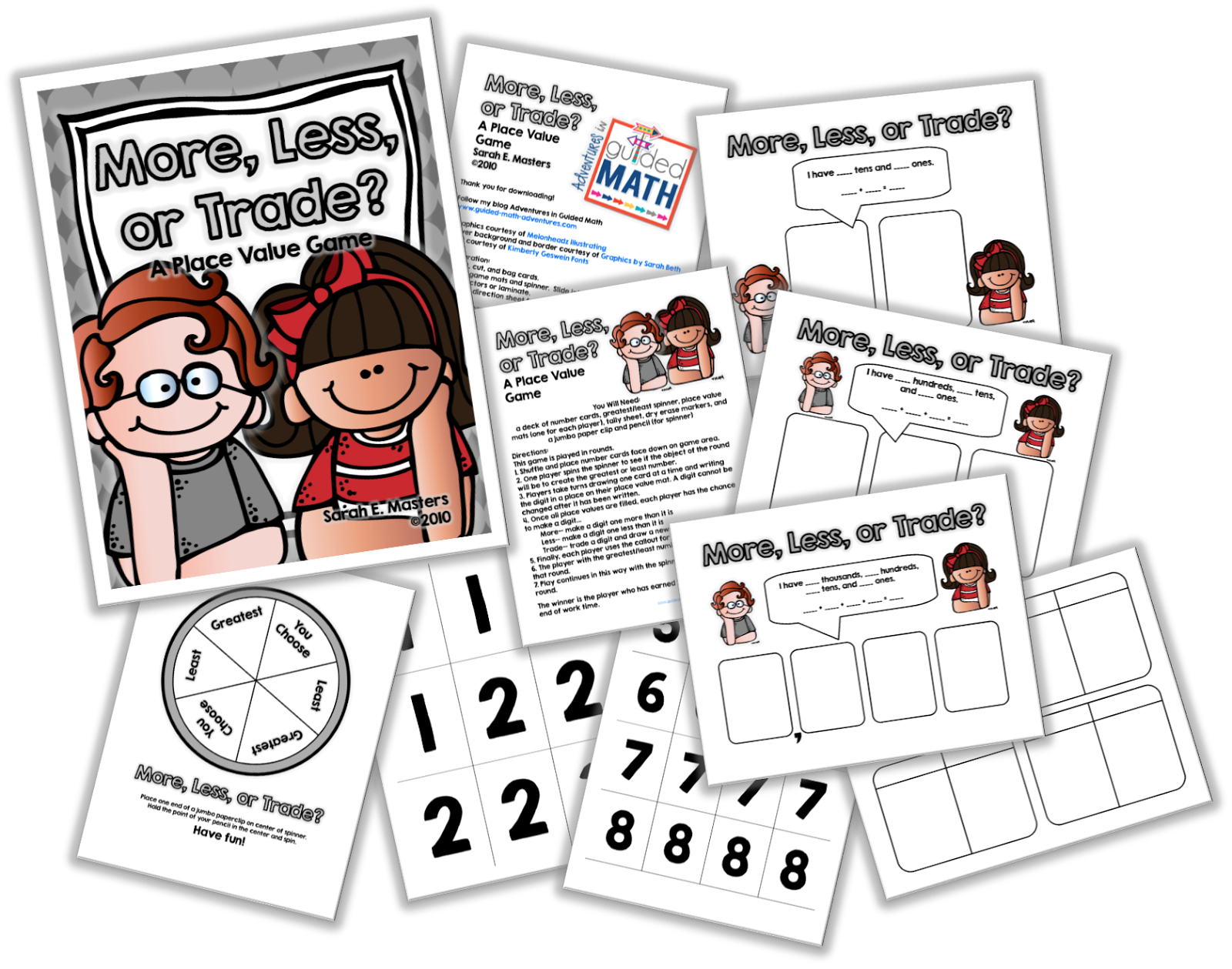
One thing I require in all place value game play is the use of callouts so that students are continually focusing on the value of each digit in a number. Feel free to download this fun place value game that my students play--More, Less, or Trade?.  Hope your kids enjoy it as much as mine have over the years!

https://drive.google.com/file/d/0B_1w1VapXOL_d1MwaGU5VVl6ZkE/view

INDEPENDENT PRACTICE!
I provide LOTS of independent place value practice for my students during guided math rotations.  Workstation games and activities are cycled throughout the year.  Place value cube activities are one of their favorites.  I have included a link where you can learn about the use of place value cubes and download directions for making your own.  There are so many possibilities for using these little buggers!


I hope you have found something that will be of use to you as you help your students develop a strong foundation.

BEFORE YOU HOP ALONG...

Feel free to sign up for the following giveaways!

The Number Line by Jeff Frykholm, Ph.D.

If you haven't already, read about using an open number line in my blog post referenced above.  Then enter to win!

a Rafflecopter giveaway

Place Value Cube Activities Pack

Enter to win some great place value cube activities that can be used in guided math groups and as workstations/centers.

http://www.teacherspayteachers.com/Product/12-Place-Value-Cube-Activities-How-to-Make-Them-773266
a Rafflecopter giveaway

Now, HOP ALONG!!  Please take the time to visit Susan at The Math Spot!

http://polkadotsandteachingtots.blogspot.com/2014/10/fly-on-math-teachers-wall-teaching.html

A thank you also goes out to Brandi from The Research Based Classroom for organizing another AWESOME blog hop!

Smiles,